ISLAMABAD: The World Economic Forum (WEF) has strongly endorsed the creation of new provinces in Pakistan, citing that adjusting administrative structures to match population growth and evolving societal needs is indispensable for effective governance and sustainable development.
According to a recent WEF analysis evaluating Pakistan alongside other emerging economies, assigning administrative systems built for smaller populations to manage sprawling urban centers and socio-economically diverse communities detaches decision-making from the public.
Pakistan serves as a clear case study for why administrative reforms are urgently required and how they should be pursued, with projections estimating the country’s population will reach 265 million by 2030.
The WEF analysis highlights that Pakistan’s existing administrative framework—spanning districts across all four provinces—dictates revenue collection, public resource distribution, infrastructure planning, emergency response, and performance monitoring.
While acknowledging significant past reforms, such as the 18th Constitutional Amendment and the 7th National Finance Commission (NFC) Award—which devolved key sectors like health and education to provinces and increased their share of divisible federal taxes from 47.5% to 57.5%—the report notes that crucial decisions remain distant from the citizens they affect.
For instance, while Lahore district holds a population of nearly 13 million, Harnai district in Balochistan accounts for just around 128,000 residents. Despite this vast disparity, policies formulated in provincial capitals attempt to address vastly different local needs through uniform mandates.
This governance gap is underscored by the Planning Commission of Pakistan’s District Education Performance Index, where none of the 134 evaluated districts achieved the “Very High” performance tier—reflecting a disconnect between policymakers and districts, budget allocations and ground realities, as well as authority and accountability.
International Precedents & Proposed Models
The report notes that several large, diverse nations periodically redraw their administrative maps in response to demographic and economic shifts. Nigeria expanded its three-region structure into 36 states by 1996; Indonesia increased its provinces from 27 to 38; and Kenya replaced eight provinces with 47 elected county governments in 2013. In large federations like Indonesia, Nigeria, and Brazil, first-tier administrative units average 6 to 8 million residents, compared to Pakistan’s average of roughly 60 million per province.
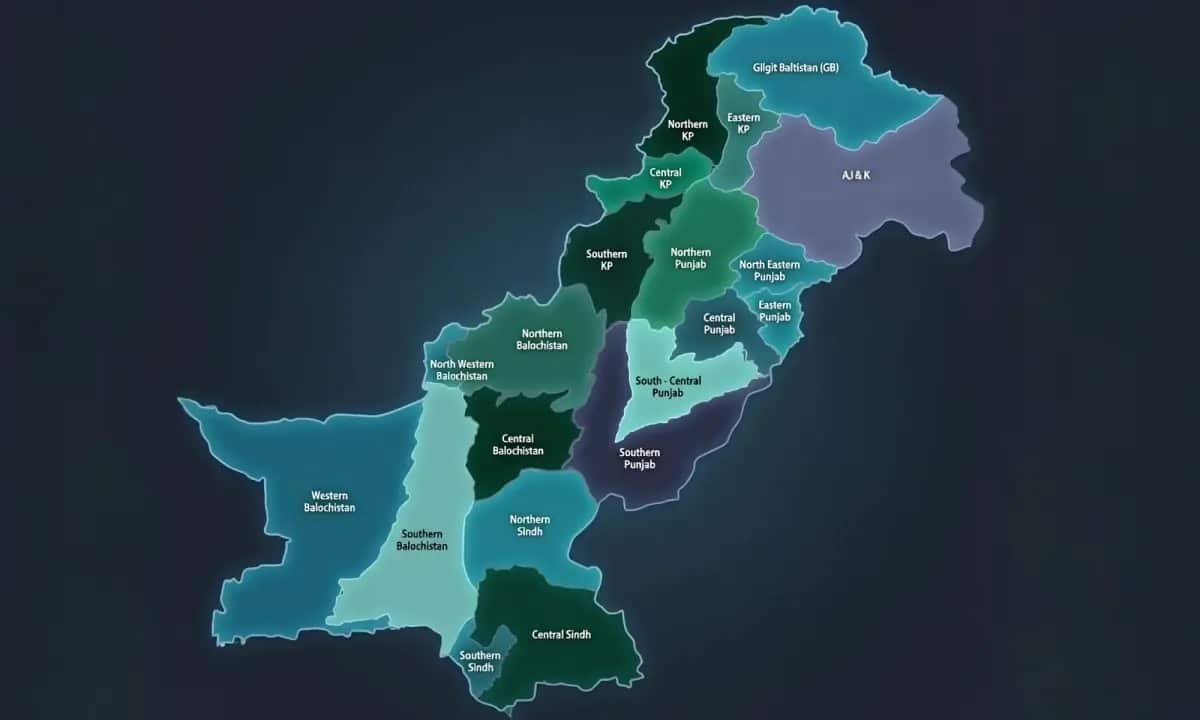
To bridge this gap, experts in the WEF analysis outlined three potential administrative restructuring proposals for Pakistan:
- 16-Province Model: Subdividing each of the four current provinces into four smaller units, reducing the average population per administrative unit from 60 million to 15 million.
- 23–25 Province Model: Re-aligning administrative units based on demographic balance and geographical harmony.
- 30+ Division-Based Model: Reorganizing administrative divisions into over 30 units, bringing average populations closely in line with major global federations.
Risks and Recommendations
While managing fewer, larger units may offer simpler legislative and financial management, creating a higher number of smaller units brings administrative power and governance closer to the people. However, the analysis cautions that this approach incurs higher transition costs and demands robust administrative capacity.
Drawing lessons from Lebanon, the WEF warns that administrative decentralization without adequate financial backing and institutional capability can lead to inefficiency. Just as over-centralization hinders public service delivery, creating smaller entities without financial autonomy and revenue-generation authority merely shifts bureaucratic inertia to the local level.
The analysis concludes that redrawing administrative boundaries must be paired with a clear reallocation of financial resources and duties to ensure lasting success.