ISLAMABAD: Afghanistan’s opium industry is witnessing a dramatic revival under Taliban rule, with poppy cultivation increasing more than fourfold in a year despite the authorities’ declared ban, raising fresh questions about the effectiveness of their anti-narcotics policy and their handling of the lucrative drug economy.
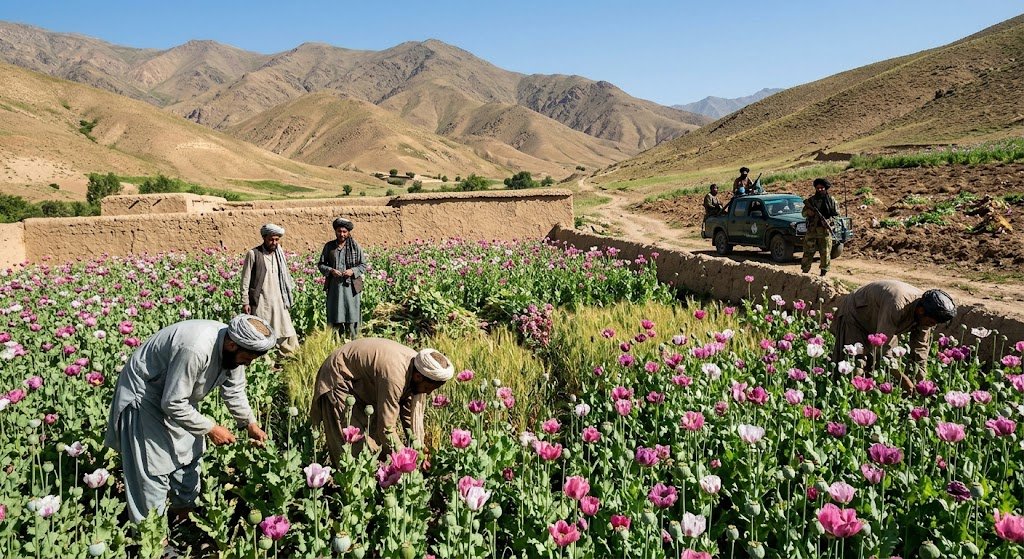
According to the latest report by the United Nations Office on Drugs and Crime (UNODC), the area under opium poppy cultivation increased from approximately 10,000 hectares in 2025 to 43,300 hectares in 2026, representing a staggering 330% increase.
Opium production has also surged nearly fivefold, climbing from around 300 tonnes last year to almost 1,500 tonnes in 2026.
The figures present a major challenge to the Taliban administration, which outlawed poppy cultivation and narcotics following its return to power, promising to eliminate Afghanistan’s decades-old drug industry.
Taliban’s ban and the growing opium economy
The Taliban announced its nationwide narcotics prohibition in April 2022, triggering a dramatic decline in poppy cultivation.
The area under cultivation fell from more than 200,000 hectares in 2022 to approximately 10,000 hectares in 2025.
However, the latest UN findings indicate that the restrictions have failed to prevent a significant expansion of cultivation, with poppy farming spreading to 16 of Afghanistan’s 34 provinces.
The scale of the increase raises questions about how such extensive cultivation has continued despite the Taliban’s claims of an aggressive crackdown.
The Taliban authorities maintain that their anti-narcotics operations remain underway. Afghanistan’s Interior Ministry says security forces eradicated more than 22,000 hectares of poppy fields in 2026, rejecting the UN’s estimates as inaccurate.
However, UNODC said it could not independently verify the reported eradication figures and found that farmers had increasingly adapted their cultivation methods to avoid detection.
Some growers reportedly concealed poppy fields among cereal crops, behind compound walls and through staggered planting and harvesting schedules.
Is the Taliban turning a blind eye?
The widening gap between the Taliban’s declared prohibition and the scale of cultivation raises questions about enforcement, accountability and the authorities’ ability to control the country’s narcotics economy.
Although the UN report does not establish direct Taliban government sponsorship of poppy cultivation, the dramatic increase presents a challenge to the administration’s claims of eliminating the drug trade.
The economic stakes are substantial. UNODC estimates that Afghan opium sales reached approximately $525 million in 2026, making the narcotics economy a significant source of income for those involved in its production and distribution.
The continued cultivation also raises questions about whether local power structures and trafficking networks are exploiting weaknesses in enforcement to sustain the trade.
Badakhshan becomes Afghanistan’s poppy cultivation hub
Afghanistan’s northeastern region has emerged as the centre of the expanding opium industry, with Badakhshan becoming a major cultivation hub.
According to UNODC, approximately 76% of Afghanistan’s poppy cultivation in 2026 was concentrated in the northeastern region.
This represents a significant geographical shift from previous years, when southern provinces such as Helmand and Kandahar dominated the country’s opium production.
Reports of clashes during eradication operations in Badakhshan in May 2026 also exposed the tensions surrounding the Taliban’s anti-narcotics campaign. Two people were killed during confrontations after security forces moved to destroy poppy fields.
Farmers interviewed by international media have described economic hardship and the risks of cultivating the crop despite the ban.
One farmer in Badakhshan told AFP that authorities threatened growers and that cultivation continued under fear of eradication operations.
Afghanistan’s drug trade and international consequences
The revival of Afghanistan’s opium industry could have far-reaching consequences for international drug trafficking networks, particularly in European markets.
Before the Taliban’s 2022 prohibition, Afghanistan accounted for approximately 80% of global illicit opium supplies and was the world’s largest producer.
The UNODC has warned that regional trafficking networks continue to operate, while existing opium stockpiles that helped maintain supplies after the ban are showing signs of depletion.
The European Union also remains vulnerable to changes in Afghan opium production, as Afghan opium has historically been a major source of heroin entering European markets.
The latest figures therefore raise concerns that Afghanistan could once again become a major supplier to international narcotics networks.
The UN has called for stronger international cooperation, investment in alternative agricultural livelihoods and improved market access for Afghan farmers, warning that enforcement alone cannot sustainably eliminate poppy cultivation.
For the Taliban administration, the growing opium economy presents a difficult question: how can it claim to have eliminated narcotics while cultivation and production are increasing so dramatically under its rule?