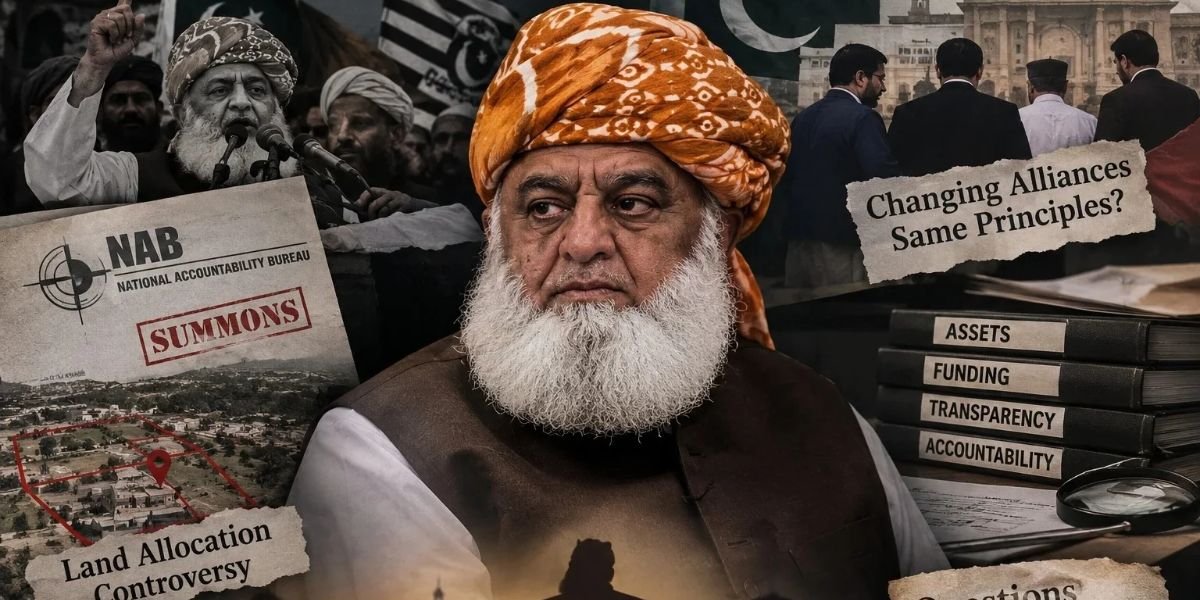
ISLAMABAD: Political and legal scrutiny surrounding Jamiat Ulema-e-Islam (F) chief Maulana Fazlur Rehman and his family has deepened amid controversial statements against state institutions, questions over asset declarations, and ongoing investigations into past ministerial decisions.
Scrutiny Intensifies Over Fazlur Rehman’s Political Rhetoric
While Fazlur Rehman’s confrontational speeches, anti-government rhetoric, and protest politics remain a major point of debate, calls have grown for regulatory and investigative bodies—including the Election Commission, the Federal Board of Revenue (FBR), and anti-corruption authorities—to thoroughly examine financial records and alleged irregularities linked to him and his family.
Statements Against State Institutions
Fazlur Rehman’s political approach has frequently featured sharp criticism of governments and state policies alongside street agitation. Recent remarks directed at the state and its institutions have drawn strong public reaction, with critics arguing that aggressive rhetoric and unsubstantiated allegations cross the line from legitimate political dissent into unlawful conduct. Observers note that while constitutional rights allow peaceful protest and political disagreement, incitement, obstruction of state authority, or unlawful acts warrant action strictly in accordance with the law.
Questions Over Electoral Filings and Asset Records
Concerns have also been raised regarding discrepancies in electoral and asset disclosures. Reports indicate that two nomination-related forms submitted on December 22, 2023, contained differing bank account details—with one listing an Allied Bank Parliament House branch account and another omitting it in favor of a different account. Calls have been made for the Election Commission and the National Assembly Speaker to review the filings and verify the accuracy of declared financial information.
Separately, media reports have pointed to an anomaly in declarations attributed to Fazlur Rehman’s spouse involving 55 tolas of gold valued at Rs 950,000 in 2023 records, which reportedly appeared under the weapons category rather than jewelry at the same valuation in 2024 filings. Questions have been raised over whether the shift stemmed from a clerical classification error or another cause.
Pakistan Post Recruitment Probe and NAB Notices
Investigations have also focused on recruitments carried out in Pakistan Post during the tenure of Fazlur Rehman’s son, former federal communications minister Asad Mehmood. Allegations center on appointments made in 2022 and 2023 that exceeded authorized limits or involved abolished posts. According to available details, against 3,938 posts permitted by the Establishment Division, 4,252 individuals were reportedly recruited, including appointments against 2,646 abolished positions.
Authorities are examining merit, domicile quotas, candidate eligibility, and procedural compliance, along with the financial burden placed on the national exchequer. The National Accountability Bureau (NAB) has issued call-up notices to Asad Mehmood; reports state he submitted a written response instead of appearing in person, which investigators deemed unsatisfactory, leading to further notices—including a third summons reported around November 17 that went unattended in person.
Islamabad Property Inquiries
Investigative agencies are also reportedly looking into real estate in Islamabad linked to Fazlur Rehman and close associates. Questions surround the ownership, purchase, transfer, and funding sources of an under-construction house in Sector G-6—a matter that has also seen reports of an arrest and disputed property transfer—as well as ownership, tenancy, and financial transactions involving another residence in the capital.
Accountability Through Documentation and Law
Taken together, the political tensions and financial inquiries have shifted focus from rhetorical exchanges to documentary verification and due process. Analysts and observers emphasize that if investigations establish deliberate misrepresentation, concealed assets, unlawful appointments, or abuse of authority, accountability must follow under the law—regardless of political stature or party affiliation.