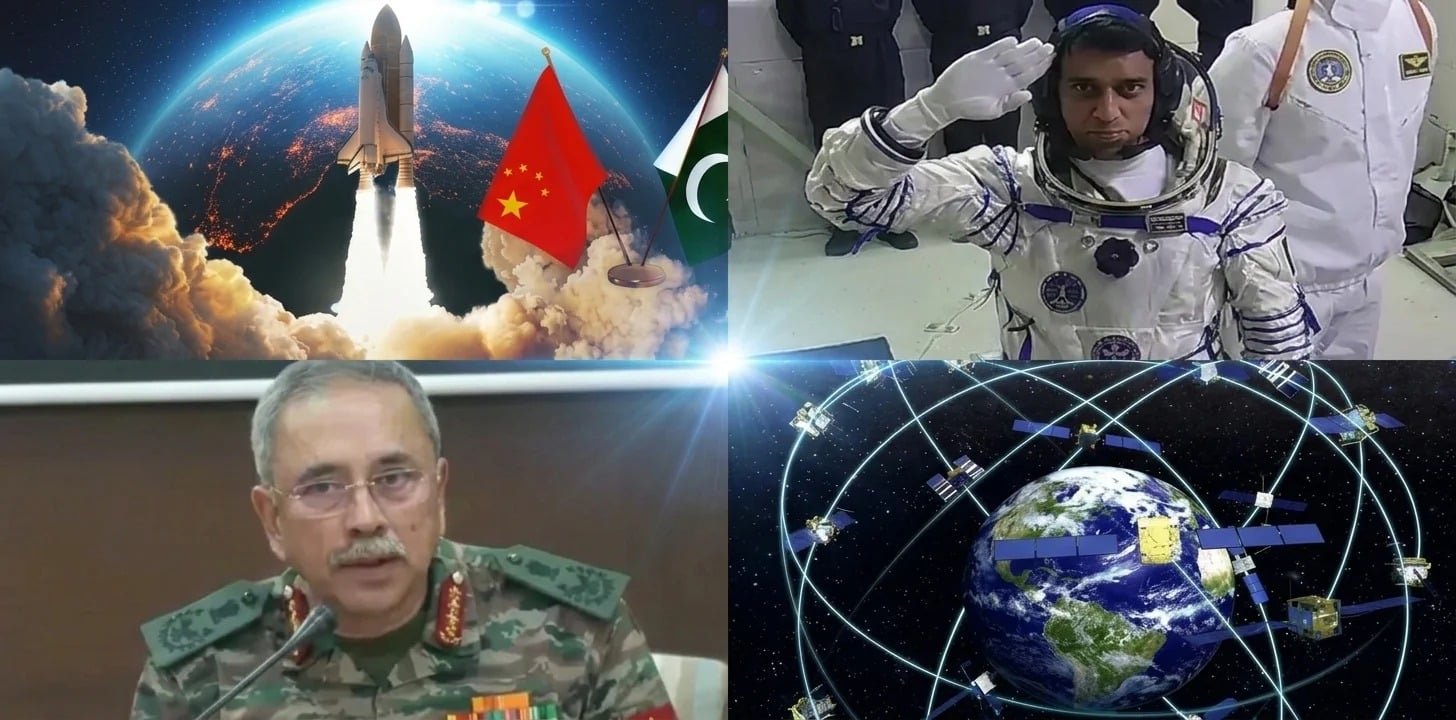
ISLAMABAD: Pakistan’s rising space capabilities have emerged as a prominent strategic discussion across regional defense circles, with international media reporting heightened security concerns in New Delhi.
According to reported remarks by Indian Chief of Defence Staff (CDS) General N.S. Raja Subramani, Islamabad’s space expansion is not limited to external support, as Pakistan is also advancing indigenous initiatives through the Space and Upper Atmosphere Research Commission (SUPARCO) alongside technical cooperation with China and potential collaboration with Turkey.
General Subramani highlighted intelligence, surveillance, and reconnaissance (ISR), positioning, navigation, and timing assets associated with strategic partnerships, urging India to accelerate its own military space capabilities and modernize multi-domain architecture.
These observations coincide with Pakistani astronaut Zeeshan Ali’s participation aboard China’s crewed space mission—having launched on November 25—for a planned stay of five to ten days conducting scientific and research activities alongside Chinese crew members.
Air Defence and Modern Warfare Weapons
Modern military doctrines increasingly tie space-based surveillance and secure communications directly to layered air defence networks and precision strike systems.
In this context, defense analysts note ongoing efforts to strengthen air defence coverage, radar integration, electronic warfare resilience, and counter-unmanned aerial systems to address high-tempo threats, loitering munitions, and saturation scenarios.
Across regional militaries, modernization has focused on combining surface-to-air missile batteries, mobile point-defence guns, sensor fusion, and command-and-control links so airspace monitoring and interception remain responsive under contested electromagnetic conditions.
Rather than relying on a single platform, contemporary air defence and modern warfare concepts emphasize networked sensors, real-time data sharing, and layered interception tiers that link detection, command decisions, and kinetic or electronic effectors across air, land, sea, and space domains.
As long-range sensors, unmanned systems, and precision-guided munitions proliferate, states continue to prioritize rapid target identification, electronic counter-measures, and resilient command networks to protect critical infrastructure and maintain operational deterrence.
Also Read: Proud Moment for Pakistan: First Glimpse of Zeeshan Ali From Space Station Revealed
Together, developments in orbital observation, airspace protection, and precision weaponry illustrate how Pakistan’s rising space capabilities intersect with broader shifts in modern defense planning.