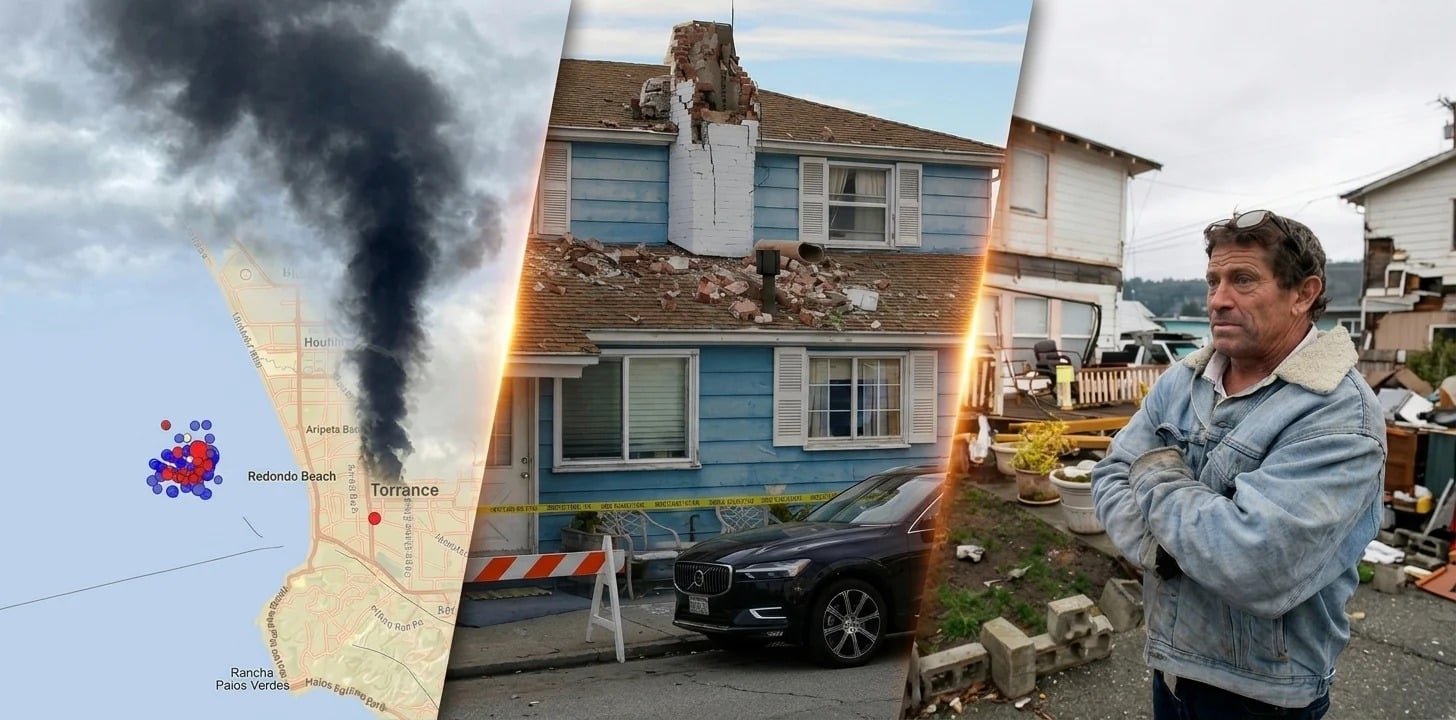
WASHINGTON: A 5.0 earthquake hits California, sparking panic and 40+ aftershocks. A California 5.0 magnitude earthquake struck the Los Angeles area, triggering widespread panic among residents and prompting emergency advisories across coastal neighborhoods.
According to foreign media reports, the initial tremor on Saturday was followed by a continuous sequence of aftershocks centered near the Manhattan Beach area.
Data released by the United States Geological Survey (USGS) confirmed that more than 40 aftershocks were recorded following the main event, including two tremors exceeding 4.0 magnitude and eight measuring above 3.0.
Local media reported structural damage to several buildings, while shattered glass was scattered across airport terminals, forcing air traffic control to abort the landing of an approaching flight near the runway.
In response to the California 5.0 magnitude earthquake, Manhattan Beach authorities issued an official notice on social media advising residents to stay clear of damaged structures and downed power lines.
Seismologists have warned that additional aftershocks around 3.0 magnitude remain likely over the next one to two weeks.
Earthquakes in the United States
Earthquakes in the United States occur predominantly along active tectonic plate boundaries, with the West Coast—particularly California, Alaska, and the Pacific Northwest—experiencing the highest frequency of seismic activity.
California sits along the San Andreas Fault system, where the Pacific and North American plates grind past each other, generating thousands of measurable tremors annually.
Beyond the West Coast, significant seismic zones also exist in the central and eastern United States, such as the New Madrid Seismic Zone in the Mississippi Valley and parts of South Carolina, where deep intraplate faults can transmit shaking across wide geographic areas.
To mitigate risks, the United States Geological Survey operates dense seismic monitoring networks alongside early warning systems like ShakeAlert, which provides seconds of advance notice before strong shaking arrives.
Also Read: Moderate 4.7 Magnitude Earthquake Jolts Zhob and Surrounding Areas
Combined with strict seismic building codes and public preparedness drills, these systems help minimize casualties and infrastructure disruption during a California 5.0 magnitude earthquake or larger regional events.