ISLAMABAD: Khyber Pakhtunkhwa’s worsening terrorism crisis has put a glaring spotlight on the consequences of Pakistan’s earlier attempt to negotiate with the Tehreek-e-Taliban Pakistan (TTP), offer reconciliation and consider the rehabilitation and resettlement of militants — a policy pursued during the Pakistan Tehreek-e-Insaf (PTI) government under former prime minister Imran Khan.
Terrorist attacks in KP increased from 111 in 2021 to 413 in 2025 — a staggering 272.1% rise, according to annual data compiled by the Pak Institute for Peace Studies (PIPS). The human cost also escalated sharply, with deaths linked to the recorded attacks rising from 169 in 2021 to 581 in 2025, while injuries jumped from 122 to 698.
The figures provide a stark backdrop to a policy that saw the then PTI government open talks with TTP factions, discuss amnesty for militants willing to lay down their arms and reintegrate into society, and later pursue plans to bring thousands of TTP fighters and their families back into Pakistan’s tribal districts.
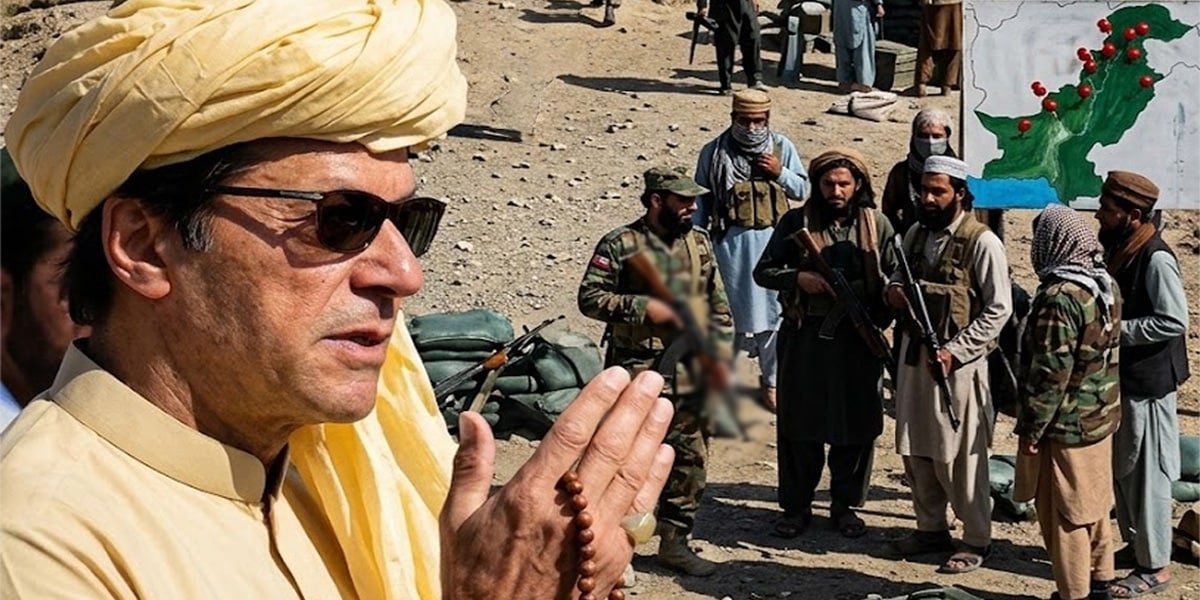
The most consequential part of that policy emerged in 2021, when Imran Khan publicly confirmed that his government was negotiating with some TTP groups as part of what he described as a “reconciliation process.” Khan said militants who surrendered their weapons could be forgiven and allowed to become ordinary citizens.
Imran Khan’s TTP Talks and Reconciliation Policy
The talks were facilitated by the Afghan Taliban after their return to power in Kabul. A month-long ceasefire began in November 2021, but the process collapsed in December after the two sides failed to resolve major differences.
The prisoner issue added another controversial layer to the negotiations. Reports at the time said the government had released more than 100 TTP prisoners as a goodwill gesture during the ceasefire. Security officials cited by The Express Tribune said many of those released had been undergoing deradicalisation and rehabilitation, although contemporary reporting was contradictory: security officials and the TTP separately denied reports of such releases in November 2021.
The issue later resurfaced when Interior Minister Mohsin Naqvi told a Senate committee in July 2024 that the release of TTP prisoners in 2021 had been a mistake, arguing that the hoped-for improvement did not materialise.
But the reconciliation policy went beyond negotiations.
After the Taliban takeover of Afghanistan in August 2021, the PTI government explored the resettlement and rehabilitation of TTP fighters and their families in Pakistan’s former tribal districts. In January 2023, Imran Khan himself disclosed that his government had planned to relocate at least 5,000 TTP fighters and their families, numbering about 35,000 people, with the help of the Afghan Taliban. He said the plan failed because provinces were unwilling to finance the initiative.
A month later, Khan defended the broader policy, saying that after the Afghan war ended, 30,000 to 40,000 Pakistani tribal fighters wanted to return, leaving the government with what he described as two options: fight them or reach an agreement allowing them to settle in the province. He argued that the returning fighters had issues that needed to be addressed to achieve peace.
There was, however, a significant dispute within the PTI itself over who initiated the resettlement proposal. Former human rights minister Shireen Mazari later said the idea of resettling TTP families had originated with then-army chief Gen Qamar Javed Bajwa, and that elected representatives from the tribal areas had opposed the proposal because of concerns about the return of militants. Her account contradicted Khan’s later description of the plan as his government’s initiative.
The security establishment’s later assessment also raised serious questions about the outcome of the talks. In December 2022, the National Counter-Terrorism Authority told a Senate committee that the peace process had “emboldened” the TTP, allowing the militant group to gain ground and expand its footprint and activities. NACTA also linked the increase in TTP activity to the group retaining a base in Afghanistan after the US withdrawal.
That assessment is particularly significant for KP, where TTP and its affiliates remain central to the militant threat. The European Union Agency for Asylum, citing PIPS, PICSS and CRSS data, reported that KP recorded the highest number of militant attacks in Pakistan in 2025, although different monitoring organisations produced substantially different totals because of differing methodologies.
TTP’s Gains During Peace Talks
PIPS data show the trajectory clearly: 111 attacks in KP in 2021, 169 in 2022, 174 in 2023, 295 in 2024 and 413 in 2025. The increase was not confined to a single year; attacks rose across the entire five-year series.
The latest figures therefore reopen a difficult question about the assumptions behind the reconciliation strategy: whether negotiations, ceasefires, amnesty discussions, prisoner releases and proposed resettlement created sufficient safeguards to prevent militants from rebuilding their networks.
NACTA’s assessment provides one official warning from the period itself: the TTP used the peace-talk process to expand its footprint. At the same time, the available data do not by themselves establish that the PTI-era reconciliation policy caused the 272.1% increase in attacks. The subsequent rise in violence also coincided with the Taliban’s return to power in Afghanistan, the TTP’s continued presence there and wider regional security developments.
What is beyond dispute is the scale of the deterioration recorded by PIPS. By 2025, KP was facing nearly four times as many terrorist attacks as in 2021, with deaths and injuries also dramatically higher.
The numbers have consequently brought renewed scrutiny to a chapter of Pakistan’s counterterrorism policy in which the state attempted to move from military confrontation toward negotiation, reconciliation and reintegration — only for the peace process to collapse and militant violence to subsequently intensify.