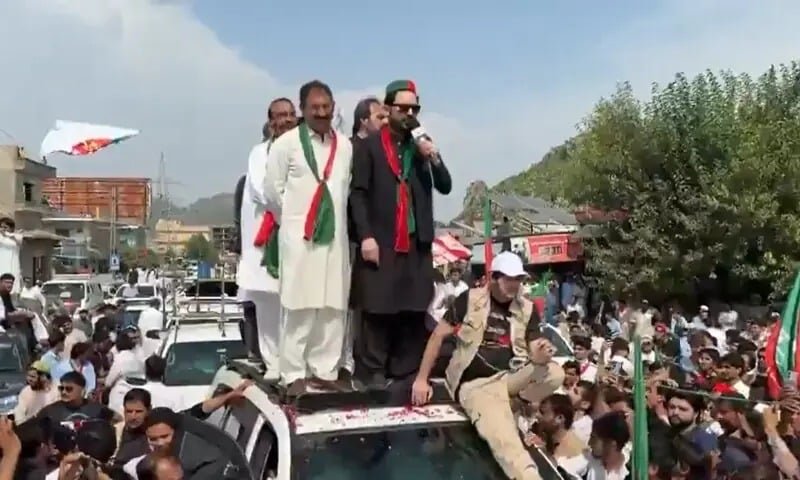
The PTI long march in KP reached a critical juncture this evening as the Chief Minister of Khyber Pakhtunkhwa, accompanied by local party leaders, crossed Lachi Bazaar and closed in on the designated rally venue. According to official updates issued at 6:00 PM on October 5, 2026, the leadership and caravan are currently situated just 1.5 kilometers away from the main gathering point at the Football Ground in Tehsil Lachi.
The PTI long march in KP has drawn an estimated crowd of 2,000 to 2,200 workers participating in the ongoing mobilization.
Local administrative and security arrangements dictate that while the general participants will stay overnight at the Lachi Football Ground, the Chief Minister will be accommodated at Aftab Alam’s Hujra on Doda Road, Kohat, under strict security protocols to mitigate potential risks.
As the PTI long march in KP continues to unfold across the Kohat Division, law enforcement agencies remain on high alert to monitor public movement and ensure overall safety.
An Analysis of PTI’s Protest Stance and Its Implications for Security and Law and Order
Over recent years, Pakistan Tehreek-e-Insaf’s (PTI) persistent reliance on street agitation, long marches, and public demonstrations has consistently placed a heavy strain on the country’s security apparatus and socioeconomic stability.
While political mobilization is a fundamental pillar of a democratic system, the party’s aggressive protest stance has frequently brought administrative machinery to a standstill, raising serious concerns among law enforcement agencies regarding public safety and the maintenance of public order.
The strategy of deploying large-scale rallies and blockades often necessitates the large-scale deployment of police and paramilitary forces, diverting critical resources away from routine counter-terrorism and policing duties.
Major thoroughfares, commercial hubs, and vital supply lines are frequently disrupted, resulting in substantial economic losses for local businesses and daily-wage earners.
Furthermore, political polarization tends to heighten tensions between party workers and state institutions, occasionally creating flashpoints that risk transforming peaceful demonstrations into volatile confrontations.
From a governance perspective, prolonged political agitation in sensitive regions like Khyber Pakhtunkhwa creates a dual challenge for provincial authorities.
The administration must balance the democratic right of freedom of assembly with its primary constitutional obligation to safeguard citizens, protect public infrastructure, and maintain civil order.
Critics and security analysts argue that institutional dialogue and parliamentary engagement offer a more sustainable framework for resolving political grievances than perpetual street mobilization.
ALSO READ: Gandapur, PTI Workers Return from March Citing Security Concerns
Ultimately, striking a balance between political expression and the preservation of public peace remains essential to preventing disruptions that undermine state stability and community welfare, highlighting the complex dynamics surrounding events like the PTI long march in KP.