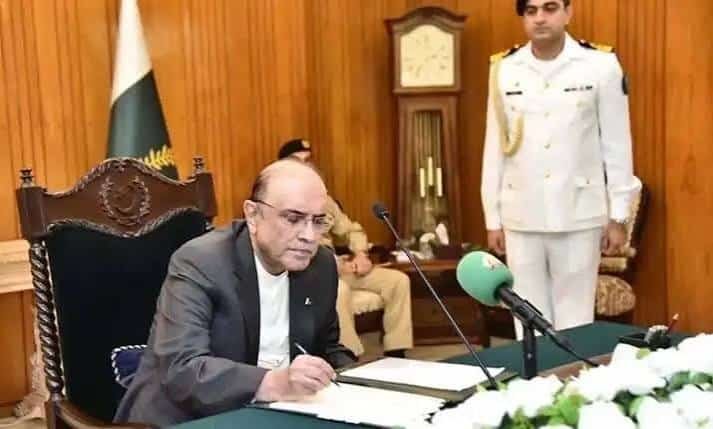
ISLAMABAD: President Asif Ali Zardari has summoned separate sessions of the National Assembly and Senate for Tuesday, October 13, at 6:15pm at Parliament House, bringing parliamentary proceedings into focus following the imposition of emergency and governor’s rule in Khyber Pakhtunkhwa.
The Constitution sets different approval requirements for emergency rule and the takeover of provincial administration.
Article 232 governs emergency proclamations concerning threats from war, external aggression or internal disturbances beyond a provincial government’s capacity to control.
However, where the president acts on his own, the proclamation must be presented to both parliamentary houses, with each required to approve it within ten days.
The article also requires the president to summon a joint sitting within thirty days of issuing the proclamation.
In this regard, unless that sitting approves it through a resolution before two months expire, the emergency ceases to remain in force.
These requirements make parliamentary consideration central to the continuation of the measure.
Article 234 concerns a situation in which provincial government cannot operate according to the Constitution. It allows the president to assume provincial executive functions or direct the governor to exercise them on his behalf.
The provision also permits provincial assembly powers to be exercised by Parliament or under its authority.
A proclamation under this article must be placed before a joint sitting. Without approval through a resolution, it expires after two months. Further resolutions can extend its duration by up to two months at a time, but its total period cannot exceed six months.
Separate Sessions Do Not Confirm a Joint Sitting
The scheduled meetings therefore carry significance, but separate sittings of the National Assembly and Senate do not automatically constitute a joint sitting.
Their summons alone also does not establish when resolutions will be introduced, debated or put to a vote. That distinction matters because approval by individual houses and approval at a joint sitting serve different constitutional purposes.
ALSO READ: PTI Leaders in Police Custody After KP Governor’s Rule
Attention will now turn to the announced parliamentary business and any subsequent notice convening a joint sitting. Together, those proceedings will clarify how the government intends to obtain approval for the measures affecting Khyber Pakhtunkhwa’s administration.