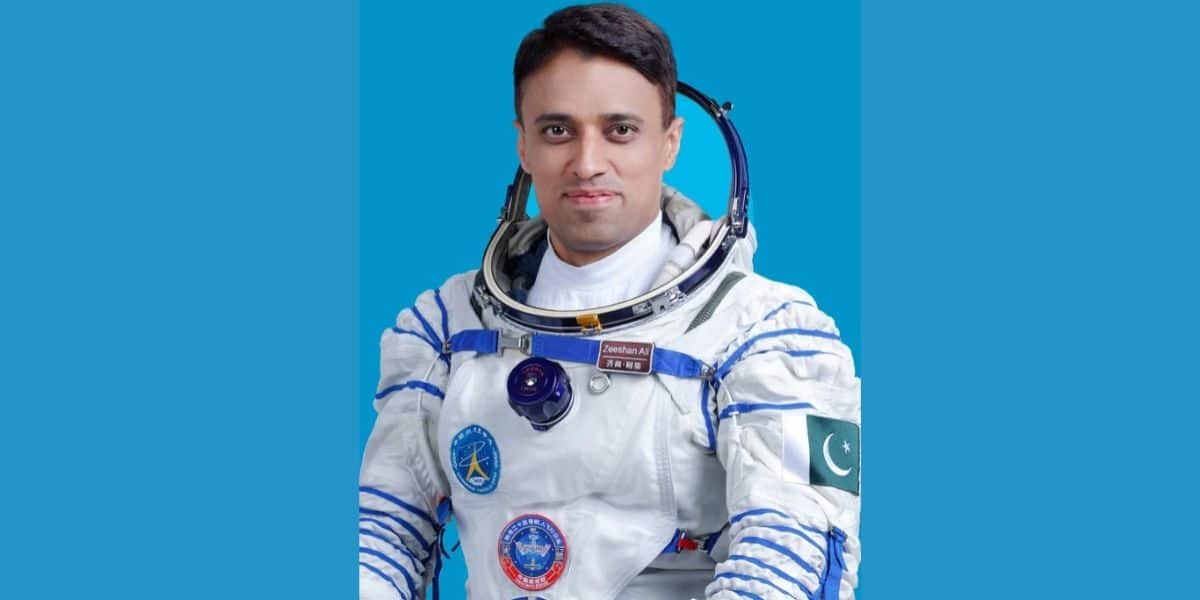
ISLAMABAD: Pakistan’s first orbital astronaut, Muhammad Zeeshan Ali, has entered space aboard China’s Shenzhou-24 spacecraft and docked with the Tiangong space station, taking on the vital role of payload specialist to oversee specialized scientific equipment and microgravity experiments.
The milestone flight—which launched from the Jiuquan Satellite Launch Center in northwestern China and docked with Tiangong after roughly three and a half hours—also marks the first time a foreign astronaut has boarded China’s space station. Ali, a 40-year-old Pakistan Air Force pilot, is flying alongside mission commander Tang Hongbo and flight engineer Wu Yi for an approximate one-week stay aboard the orbital laboratory.
What Is a Payload Specialist?
In spaceflight terminology, a payload refers to the scientific instruments, experimental hardware, research samples, and technical equipment carried beyond the spacecraft’s crew and core life-support or propulsion systems.
A payload specialist is a dedicated crew member responsible for operating, monitoring, and managing those specific experiments and instruments so the mission’s scientific goals are achieved safely and accurately. While the title became widely known during NASA‘s Space Shuttle program, modern crewed missions assign payload duties to specially trained astronauts selected for specific research objectives.
Zeeshan Ali’s Key Duties in Orbit
During his roughly week-long assignment aboard Tiangong, Ali’s primary focus is initiating scientific research and ensuring hardware readiness in microgravity:
During the mission, the astronaut will install and activate experimental equipment and scientific samples, ensuring they have withstood launch vibrations and forces and are functioning properly in microgravity. He will conduct multidisciplinary scientific investigations in fields such as biology, physics and chemistry, while supporting four biotechnology experiments selected by SUPARCO from more than 300 proposals submitted by Pakistani universities. These experiments focus on critical areas such as food security and climate change, alongside research involving photosynthetic microorganisms. His responsibilities will also include recording experimental observations, monitoring performance, and transmitting scientific data to research teams on Earth. The complete cycle of the four Pakistani university experiments is expected to take between six and 12 months, with in-orbit calibration and minor technical adjustments carried out whenever required.
Career Astronauts vs. Payload Specialists
A payload specialist does not necessarily begin as a career or professional astronaut; scientists, researchers, and technical specialists have historically been chosen for specific missions and given targeted spaceflight training—including centrifuge runs, emergency drills, simulator practice, and, in Ali’s case, Mandarin language training to coordinate closely with his Chinese crewmates