PESHAWAR: A digital-forensics analysis of a newly released training video attributed to Jamaat-ul-Ahrar (JuA) has identified what analysts describe as a militant training camp in Afghanistan’s Nangarhar province, raising fresh questions about the presence of Pakistan-focused militant networks on Afghan soil.
The video, titled Mu’askar al-Haqqani, reportedly shows armed cadres assembled at a camp that the analysis places in Goshta district, near the Pakistan-Afghanistan border. The findings challenge repeated denials by the Afghan Taliban authorities that groups such as Tehreek-e-Taliban Pakistan (TTP) and Jamaat-ul-Ahrar operate from Afghanistan.
According to the analysis, digital records embedded in the video’s production files point to a media operation using Afghanistan’s local system time, UTC+04:30. The metadata of a master poster reportedly contains 12 consecutive Adobe Photoshop save records spanning 18 months, all displaying the same time zone.
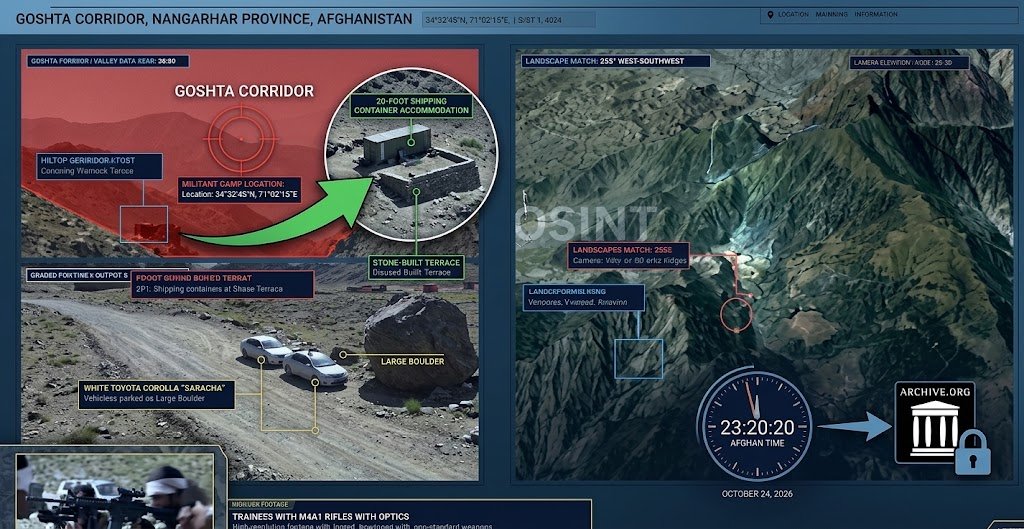
The analysis also traces the video’s alleged upload sequence. It says the final version was exported at 23:20:20 Afghan time on October 24, 2026, before appearing on Archive.org approximately 35 minutes later. The uploader’s email address has been withheld for privacy reasons.
The production files reportedly reveal the use of two video-encoding systems: HandBrake for a 720p version and FFmpeg for a 1080p version. The analysis also identifies Android-based Telegram distribution, which it says points to an organised media-production and distribution setup rather than an isolated recording.
Analysis pinpoints camp in Goshta
By comparing ground footage with three-dimensional satellite elevation models, the analysts have placed the alleged camp in Goshta district of Nangarhar province at coordinates 34°32’45″N, 71°02’15″E, at an estimated elevation of 1,623 metres.
They say the camera view recorded between 8am and 8:06am, facing approximately 255 degrees west-southwest, matches a ridge and a V-shaped ravine visible in satellite terrain models. The analysis further claims that the site occupies a disused Afghan Border Police outpost.
The footage reportedly shows a 20-foot shipping container used as accommodation, a stone-built terrace and an elevated hilltop observation post. It also shows groups of men gathered beneath a large boulder beside a graded dirt track.
Vehicles and US-origin weapons visible
The analysis identifies white Toyota Corolla station wagons, locally known as Saracha, parked along the track. It also identifies M4A1 rifles fitted with Picatinny rails and optical sights in the hands of trainees.
The analysts describe the weapons as equipment originally supplied to Afghanistan’s former security forces and subsequently looted from government stockpiles after the Taliban takeover in August 2021.
Taken together, the video and its associated digital records are presented as evidence of an established training and media operation in Nangarhar. However, the material does not, by itself, establish who controls the site or prove that Taliban authorities directly authorised or protected it.
UN reports have repeatedly flagged militant networks in Afghanistan
The findings come amid growing international concern over militant groups operating from Afghanistan and the threat they pose to neighbouring countries.
In its December 2025 report to the UN Security Council, the Analytical Support and Sanctions Monitoring Team estimated that TTP maintained around 6,000 fighters, with a presence in Khost, Kunar, Nangarhar, Paktika and Paktia. The report also identified Jamaat-ul-Ahrar leader Mukarram Shah, known as Umar Khorasani, as being in Lal Pura district of Nangarhar.
The same report said Taliban authorities continued to provide TTP with logistical and operational space and financial support. It also warned that TTP attacks inside Pakistan had increased and contributed to worsening relations between Islamabad and Kabul.
More recently, the Monitoring Team’s 38th report, issued in August 2026, said the ability of numerous terrorist groups to operate in Afghanistan constituted an enduring threat to neighbouring countries and Central Asia. It reported that Taliban authorities had been unable to suppress the wider terrorist threat despite operations against Islamic State Khorasan Province and efforts to contain other militant groups.
The report also highlighted TTP’s escalating attacks against Pakistan and described Afghanistan as a permissive environment for several militant organisations. It noted that the Taliban had relocated around 2,000 TTP fighters and their families farther inside Afghanistan, while reporting that Al Qaeda continued to provide ideological guidance, training and support to TTP.
The UN findings have been echoed in international reporting. Dawn, citing the August monitoring report, reported growing operational and facilitation links among TTP, Al Qaeda, ISIL-K and the Baloch Liberation Army. Amu TV also reported that Taliban spokesman Zabihullah Mujahid rejected the UN assessment, maintaining that the groups identified in the report were not active in Afghanistan.
Separately, the UN Security Council’s sanctions listing identifies Jamaat-ul-Ahrar as a TTP splinter group based in Lalpura, Nangarhar, and records its involvement in deadly attacks in Pakistan.
The latest video analysis adds a specific alleged camp location and digital-production trail to an already documented international concern. If independently verified, the findings would further underline the challenge posed by militant networks operating across the Afghanistan-Pakistan border and the need for credible action against their training, logistical and media infrastructure.