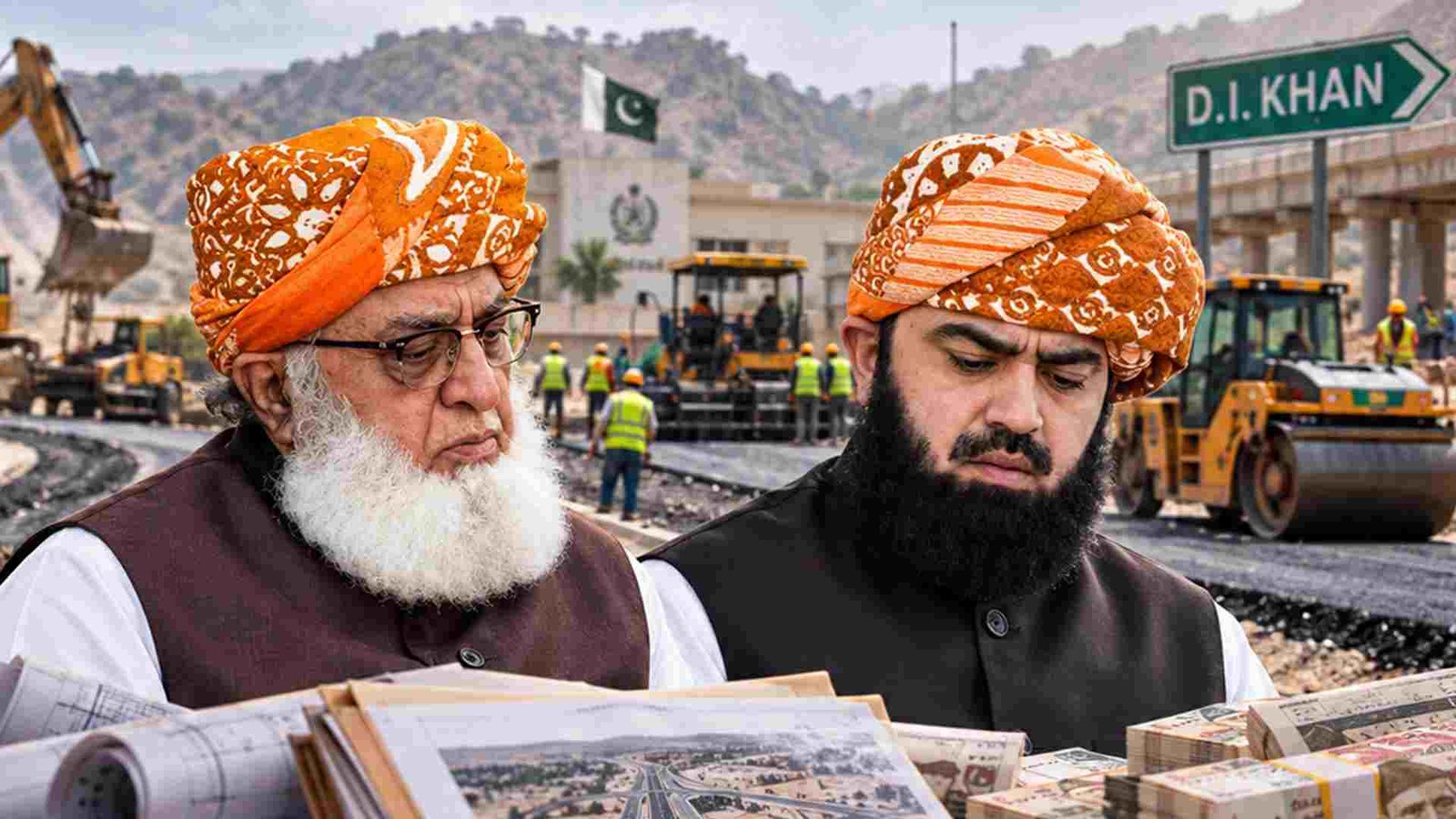
PESHAWAR: A multi-billion-rupee road scandal has exposed deep political hypocrisy at the heart of Jamiat Ulema-e-Islam (JUI-F), directly entangling party chief Maulana Fazlur Rehman and his son, former Federal Minister for Communications Asad Mahmood.
While the father Fazlur Rehman routinely uses religious authority and moral grandstanding to lecture the nation on governance, official records reveal that under his son’s ministerial watch, state funds meant for their impoverished home district of Dera Ismail Khan were bloated by a staggering PKR 5.10 billion—a budget expansion of over 316 percent.
During his tenure as Communications Minister in the PDM coalition government from April 2022 to August 2023, Asad Mahmood ordered the re-tendering of five key road infrastructure projects in DI Khan.
What followed was an unprecedented surge in project costs that transformed a modest PKR 1.61 billion regional layout into a massive PKR 6.71 billion taxpayer liability.
Four of the five contracts saw immediate, artificial price jumps of 51% to 55%. However, the most egregious instance of political pork-barreling occurred on the N-55 Highway segment connecting Qureshi Mor to Muriali Road.
Originally estimated at a modest PKR 145.2 million, the contract value was quietly re-approved at PKR 765.9 million—a mind-boggling 427.4% price hike for a single stretch of asphalt.
Neither the Ministry nor the National Highway Authority (NHA) has produced a single technical justification, scope expansion, or engineering audit to rationalize how a local bypass suddenly became four times more expensive overnight.
Tampered Data and Tendering Irregularities
The scandal strikes at the integrity of state procurement standards. Internal documentation reveals that two contradictory versions of the NHA’s Composite Schedule of Rates (CSR 2022) dataset were used during the re-tendering process. Crucial baseline structural data and geographic measurements for several road sections simply vanished from official tender files, masking how revised estimates were calculated to match inflated contractor bids.
Insiders point to classic political cronyism: re-tendering projects under the guise of “market adjustments” to channel lucrative, inflated state contracts toward favored entities within the JUI-F’s political orbit in southern Khyber Pakhtunkhwa.
Pervasive Poverty vs. Political Windfalls
The sheer scale of this fiscal manipulation stands in stark contrast to the ground reality of Dera Ismail Khan. Long treated as the personal political fiefdom of the Fazl family, DI Khan remains burdened by severe poverty, crumbling municipal services, and chronic security threats.
While ordinary citizens navigate broken infrastructure and economic hardship, billions in state resources were maneuvered into bloated contracts under the direct authority of Maulana Fazlur Rehman’s son.
Calls are mounting from anti-corruption campaigners and political opponents for the National Accountability Bureau (NAB) and the Auditor General of Pakistan to initiate immediate criminal inquiries. Critics argue that religious credentials and political leverage must no longer serve as a shield against public accountability. Asad Mahmood and Maulana Fazlur Rehman now face severe questions regarding who authorized the PKR 5.10 billion payout, where the excess public funds went, and why the people of DI Khan were used as a backdrop for dynastic financial enrichment.