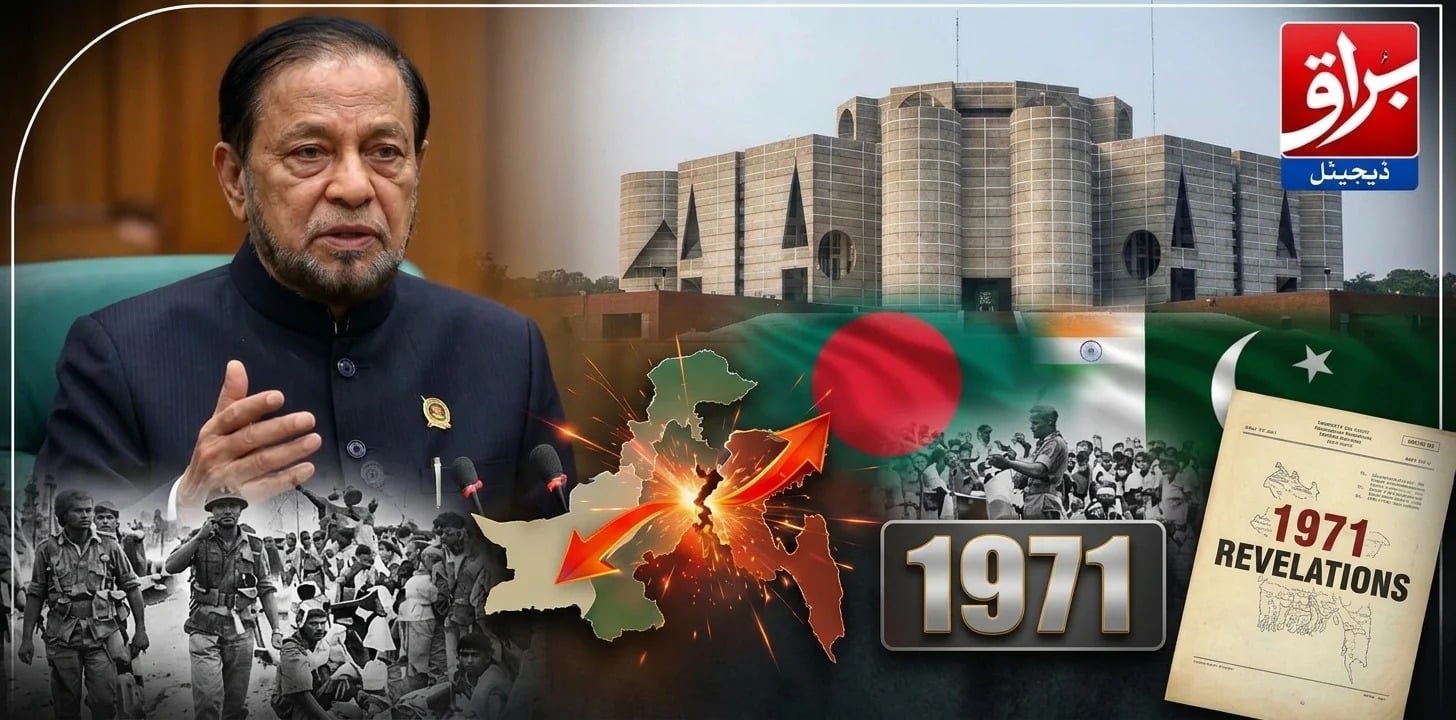
ISLAMABAD: India weakened Pakistan in 1971 instead of helping Bengalis, Bangladesh Parliament Speaker Hafiz Uddin Ahmad declared during an official visit to Islamabad.
Speaking to journalists at Parliament House, the visiting Speaker asserted that Bangladesh had effectively been turned into a colony of its neighboring country over the past 15 years, leaving ordinary citizens to suffer under external dominance.
Addressing the political situation in Dhaka, Hafiz Uddin Ahmad stated that former Prime Minister Sheikh Hasina would go straight to jail upon returning to Bangladesh, noting that she has taken refuge in an anti-Muslim state and will not return for the next 10 years.
He warned that if New Delhi refuses to extradite her, Dhaka will approach the International Court of Justice.
Describing the Awami League as a terrorist organization, he revealed that the Bangladeshi government is considering banning the party, emphasizing that Bengalis are democratic people who reject all forms of dictatorship—just as they demanded true democracy in 1971.
Pointing to similarities between the parliamentary systems of Pakistan and Bangladesh, Ahmad noted that the one-party rule imposed in 1975 deprived the nation of genuine democracy until transparent elections were held in February this year.
He also called for resolving the Kashmir dispute in accordance with United Nations resolutions and thanked Pakistan for supporting Bangladesh’s candidate for the Inter-Parliamentary Union Executive Committee.
Reaffirming bilateral goodwill, he reiterated that India weakened Pakistan in 1971 instead of helping Bengalis and stressed that friendship between Islamabad and Dhaka will continue to deepen.
India’s Backed Conspiracies in Bangladesh
For more than a decade and a half, New Delhi exerted deep political, economic, and security influence over Dhaka to advance its regional hegemony at the expense of Bangladeshi sovereignty.
Through unequal transit agreements, unfair water-sharing arrangements over common rivers, and persistent border killings by Indian forces, India systematically undermined Bangladesh’s national interests while propping up an authoritarian regime aligned with New Delhi.
Indian intelligence and diplomatic networks actively interfered in Bangladesh’s domestic politics, backing rigged elections and suppressing opposition voices to keep compliant leadership in power.
By turning Bangladeshi institutions and trade corridors into instruments serving Indian strategic goals in Northeast India, New Delhi sought to keep Dhaka politically dependent and economically subservient.
Also Read: Pakistan Rejects Indian Allegations at UN, Reaffirms Validity of Indus Waters Treaty
Following the collapse of the previous regime, ongoing disinformation campaigns and cross-border political sheltering continue to reflect New Delhi’s efforts to destabilize Bangladesh’s democratic transition and obstruct its independent foreign policy.