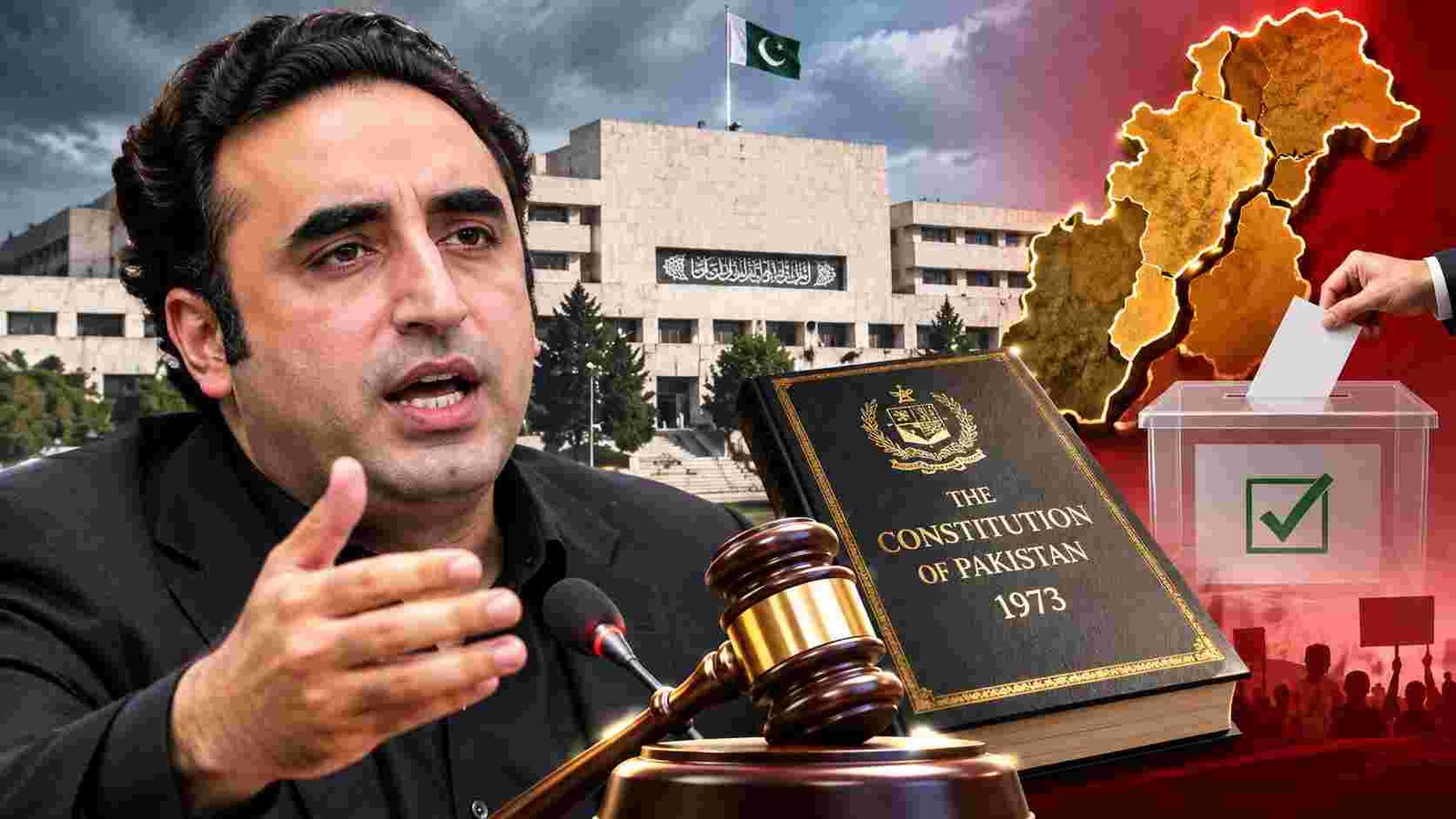
ISLAMABAD: Pakistan Peoples Party (PPP) Chairman Bilawal Bhutto-Zardari has called for general elections within six months instead of a referendum on the creation of new provinces, triggering questions over his party’s selective approach to democracy and constitutional principles as the debate over administrative restructuring intensifies.
At a time when proponents of new provinces argue that administrative restructuring is essential for effective governance and Pakistan’s future, Bilawal has demanded electoral reforms followed by fresh elections, rather than allowing the question to be put before voters through a referendum.
His position has raised an uncomfortable question for the PPP leadership: why does the party now insist on fresh elections before a major political decision when it supported sweeping constitutional changes during the tenure of the current parliament without making a similar demand?
Since the adoption of the 1973 Constitution, 27 constitutional amendments have been enacted. The PPP, under Bilawal’s leadership, supported the 26th and 27th Amendments, voting in their favour. Yet, the party did not insist that fresh general elections be held before those fundamental constitutional changes were made.
The contrast has put Bilawal’s latest appeal to democracy and constitutional propriety under scrutiny, particularly when the proposed debate concerns the future administrative structure of the country.
“If, instead of a referendum, electoral reforms are introduced and elections are held within six months, we will win again and show why the people of Sindh voted for us,” Bilawal said during a television interview.
Constitution Does Provide for a Referendum
Bilawal described a referendum on the issue as unconstitutional and argued that it would be inappropriate to set aside the Constitution to hold one. However, his assertion overlooks an explicit provision of the Constitution itself.
Article 48(6) provides a mechanism for holding a referendum on a matter of national importance. Under the provision, the prime minister may refer the matter to a joint sitting of Parliament and, if approved, have it put to the public in a yes-or-no referendum.
The constitutional framework also sets out a separate requirement for changing provincial boundaries. Under Article 239(4), any constitutional amendment altering the limits of a province must secure the support of at least two-thirds of the total membership of that province’s assembly.
In other words, the Constitution provides for a national referendum, while also protecting the constitutional role of the provincial assembly concerned in any alteration of provincial boundaries. The existence of these provisions makes a blanket assertion that a referendum is unconstitutional difficult to sustain.
Bilawal argued that a proposed referendum would effectively become a Lahore-based exercise, with people in Sindh, Balochistan and Khyber Pakhtunkhwa having no say. He also called on law enforcement agencies to guarantee peace and security in Sindh if such a vote were held.
He further rejected suggestions that the issue had been discussed during meetings between President Asif Ali Zardari and Interior Minister Mohsin Naqvi in Nawabshah, or between the president and prime minister in Lahore.
Bilawal Questions Mohsin Naqvi’s Role in New Provinces Debate
Reacting to the discussion over a possible system reset and the creation of new provinces, Bilawal said he had not initiated the debate but insisted that those raising the issue should also be prepared to listen to opposing views.
He questioned why the Pakistan Cricket Board (PCB) chairman was initiating discussions about resetting the political system and creating new provinces.
“Is this how Pakistan will function, with the PCB chairman starting a debate on how the system should be reset and new provinces created? Has the responsibility for deciding a system reset been handed over to the PCB?” he asked.
Bilawal also took a swipe at Mohsin Naqvi, saying that while he advocated a referendum on the division of provinces, he would struggle to identify the locations of Sindh’s cities on a map.
Sindh’s Division: Bilawal Warns of Bloodshed
The PPP chairman adopted a particularly strong tone when discussing the possibility of Sindh’s division, warning that any attempt to impose it by force could trigger unrest and bloodshed.
He insisted that he was not threatening anyone but issuing a warning about the possible consequences, drawing parallels with what he described as attempts to create divisions in Sindh during the 1980s and 1990s.
Bilawal said PPP workers would not take up arms even if the province’s division were imposed by force. However, he warned that such a move could ignite a situation that would become difficult to control.
He also referred to the past involvement of the Muttahida Qaumi Movement (MQM) in armed activity and the Jamaat-e-Islami’s Thunder Squad, arguing that Karachi’s history of political violence should not be ignored.
He further raised the possibility of economic disruption, asking what would happen to the country’s economy if goods leaving Karachi Port could no longer be transported out of the country.
PPP Says It Will Continue Supporting Shehbaz Government
Despite the growing political disagreement, Bilawal said he still wanted Prime Minister Shehbaz Sharif to succeed and that the PPP would continue supporting the coalition government despite what he described as the attitude of its allies.
He maintained that the party’s political future did not depend on securing positions such as a governorship or the chairmanship of the Senate.
However, his remarks have brought the debate back to a fundamental political question: whether democratic principles and constitutional procedures should be applied consistently, or invoked more forcefully when a proposed national reform challenges a party’s political position in its own stronghold