SEOL: South Korean education minister resigns over AI exam cheating scandal, stepping down after intense public criticism and scrutiny over last-minute anti-cheating measures ahead of the country’s crucial university entrance examination.
According to AFP, Education Minister Choi Kyo-jin tendered his resignation following fallout from a high-profile cheating incident that emerged just days before the national College Scholastic Ability Test (CSAT), widely known as Suneung.
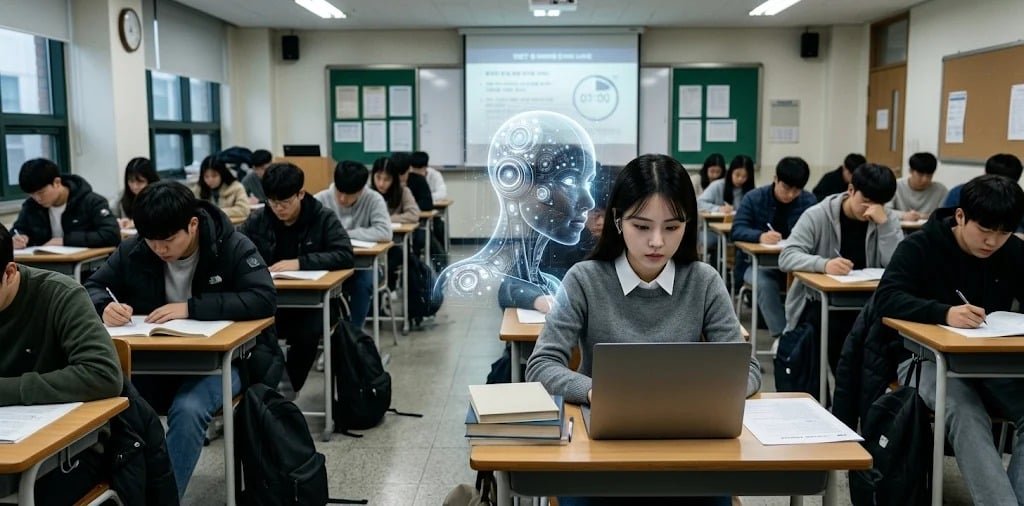
The controversy erupted when a top-scoring candidate in a national tax accountant exam confessed on YouTube—identifying himself only as “Han”—that he had used a miniature camera, a smartphone, and an artificial intelligence tool to photograph exam questions and receive real-time answers during tests held in April and July.
With over 550,000 students taking the nine-hour Suneung across roughly 1,300 test centers, authorities deployed 8,400 additional invigilators, disabled public Wi-Fi, placed stickers over clothing buttons, and used metal detectors.
In an unprecedented step, the government also triggered three 10-second emergency mobile alerts across nine cities—even on phones set to silent mode—to detect concealed devices.
Out of 111 electronic device violations recorded during the exam, nearly half were uncovered through these alerts.
Despite these measures, criticism mounted after the 72-year-old minister remarked during a parliamentary hearing that, due to his age, he could not be certain officials would catch every cheater.
In a statement on X, Choi acknowledged responsibility for the government’s lack of advance preparation and resigned once the exam concluded without major disruption. President Lee Jae-myung subsequently accepted his resignation, marking a dramatic political consequence as the South Korean education minister resigns over AI exam cheating scandal.
AI’s Drawbacks Globally Proven
Across the globe, rapid adoption of artificial intelligence has exposed major ethical, academic, and security vulnerabilities.
In education, AI-assisted plagiarism and real-time cheating tools have undermined standardized testing and weakened critical thinking among students.
Beyond classrooms, generative AI has fueled sophisticated deepfake fraud, automated cyberattacks, and widespread misinformation campaigns that threaten public trust and democratic processes.
Algorithmic bias in hiring, healthcare, and law enforcement has also been documented internationally, leading to unfair outcomes for marginalized groups.
ALSO READ: Fake candidates caught while attempting MDCAT
Additionally, over-reliance on automated systems raises concerns about data privacy breaches, intellectual property theft, and workforce displacement across multiple industries.