
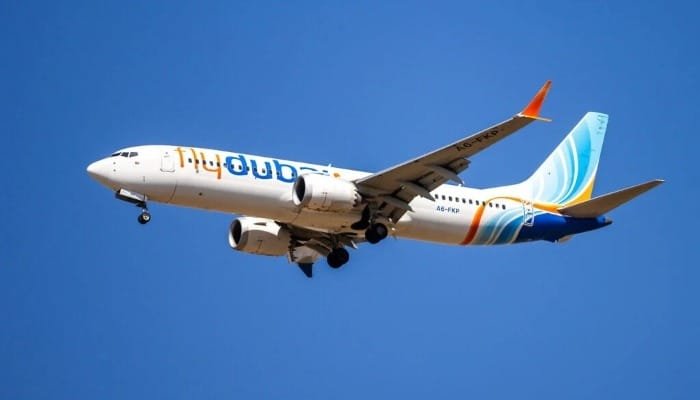
TEL AVIV: A Passengers Aircraft carrying 150 Israelis was forced to land in Saudi Arabia after the quarrel between the pilots.
According to the Israeli media report, the aviation sector witnessed a dramatic event on Wednesday as Flydubai flight FZ1073, traveling from Dubai to Tel Aviv, was forced to make an emergency landing at Tabuk Airport in Saudi Arabia.
The abrupt diversion followed what officials described as a violent physical altercation between the pilots in the cockpit, narrowly averting a major catastrophe.
According to flight-tracking data, the Boeing 737 MAX, carrying over 150 Israeli passengers, initially transmitted squawk code 7700, indicating a general emergency.
Shortly after, the aircraft briefly switched to squawk code 7500, the international signal for a hijacking or unlawful interference.
As the altitude and trajectory of Flydubai flight FZ1073 fluctuated rapidly, Israeli authorities scrambled Air Force fighter jets to intercept the plane amidst fears of a terror plot.
However, the aircraft ultimately turned away from Israeli airspace, crossing Jordan before landing safely under the supervision of Saudi security forces in Tabuk.
A spokesperson for the Israeli Prime Minister clarified that the event was not a standard hijacking.
Instead, senior Israeli officials stated that a severe disaster was prevented following a confrontation in the cockpit. Initial reports indicate that the co-pilot may have attempted to seize control and intentionally crash the aircraft, prompting the distress signals before the crew and passengers intervened.
Investigations are currently underway to uncover the full sequence of events.
Intelligence Operations and False Flag Concerns
In the complex landscape of Middle Eastern geopolitics, incidents involving commercial aviation or sudden security alerts often bring historical precedents of espionage and covert operations into the spotlight.
Over the decades, the region has been a focal point for intense intelligence warfare, where various state actors, including Israel, have faced accusations of plotting or executing “false flag” operations against Muslim countries.
A false flag operation typically involves covert actions designed to appear as though they were carried out by other entities, aiming to manipulate public opinion, justify military intervention, or destabilize adversarial nations.
Historically, the Lavon Affair in 1954 is frequently cited as a documented instance where Israeli military intelligence recruited operatives to plant bombs inside Egyptian, American, and British-owned civilian targets in Egypt.
The goal was to create chaos and blame it on the Muslim Brotherhood or other local factions to influence geopolitical outcomes and retain a British military presence in the Suez Canal zone. While this specific plot failed and became a public scandal, it cemented a lasting atmosphere of profound suspicion in the region.
In more recent times, whenever ambiguous or highly sensitive security incidents occur, regional analysts frequently caution against jumping to conclusions.
While there are no confirmed reports or alleged evidence linking the recent aviation emergency of Flydubai flight FZ1073 to any state-sponsored false flag plot, the historical backdrop inherently fuels public speculation.
ALSO READ: Malaysia Helicopter Crash Claims Flying Doctor Service Chopper
Security and intelligence agencies remain hyper-vigilant, carefully analyzing every anomaly to ensure that isolated emergencies are not part of a broader, orchestrated attempt to escalate regional tensions.