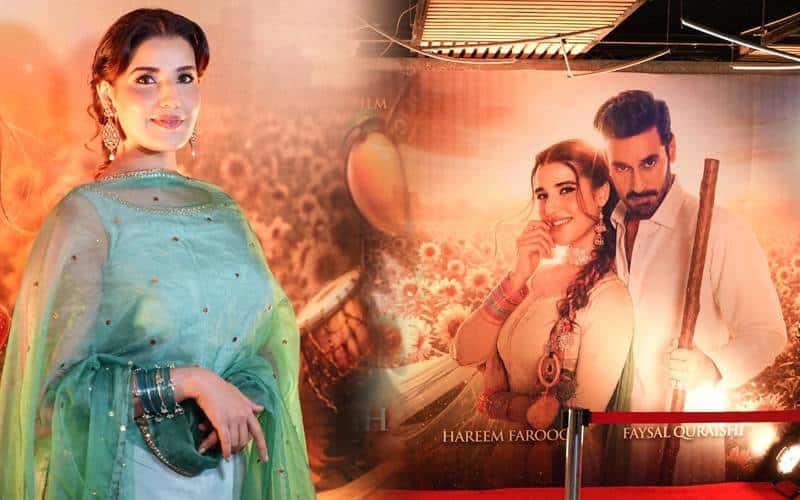
KARACHI: Pakistani actor and producer Hareem Farooq is taking aim at long-standing stereotypes surrounding Punjabi cinema with her upcoming film Mango Jutt, which she says celebrates Punjab’s cultural identity while challenging the conventional portrayal of Punjabi women on screen.
The Punjabi-language film, featuring Farooq opposite Faysal Qureshi, is scheduled for a worldwide theatrical release on October 16, including in Pakistan, the United Kingdom, the United States, the United Arab Emirates and Canada.
Farooq, who has produced the film under her banner Hameem Films, said she had wanted to make a Punjabi film for at least a decade. Her goal, she explained, was to present a more positive image of Punjab and encourage people to embrace their language, culture and identity without feeling the need to apologise for them.
“You can watch it with your family and you can let your children not be apologetic about Punjab,” Farooq told Arab News.
Her remarks address criticism that followed sections of Punjabi cinema, particularly during the 1990s and early 2000s, when some films drew objections over dance sequences and content that audiences considered unsuitable for family viewing.
Farooq said such portrayals had damaged the image of Punjabi cinema and contributed to a broader problem in Pakistan’s film industry, which she believes must offer audiences stronger, more inclusive and family-friendly entertainment.
“That was something that really hit me hard, that we should not be apologizing for our language, we should not be apologizing for our identity,” she said.
Against that backdrop, Mango Jutt aims to combine mainstream entertainment with a more confident representation of Punjabi culture. Farooq described the film as a blend of romance, action, comedy and drama, arguing that cinema should entertain audiences while giving them something they can embrace with pride.
Challenging the Punjabi heroine stereotype
Farooq plays Noor Jehan, whom she describes as a quintessential Punjabi Jutti — a woman from the Jutt community, which has a prominent agricultural and landowning presence across Punjab.
However, rather than relying solely on familiar screen conventions, Farooq said she wanted to portray a woman whose strength does not erase her vulnerability.
She described Noor Jehan as strong-headed but soft-hearted, shaped by hardship yet capable of retaining her gentleness. For Farooq, the character presented an opportunity to explore the emotional complexity of a woman navigating past experiences while finding the courage to move forward.
“For me it was a very complex character, and it was very interesting to play with that,” she said.
The role also challenged Farooq to reconsider the established image of the Punjabi heroine. Although people had often told her that she had the personality and physical appearance associated with a Jutti, she said bringing that identity to the big screen required more than simply fitting a familiar mould.
Farooq argued that Punjabi women should appear on screen with the confidence, individuality and pride that define their identity, rather than being confined to narrow expectations of how they should look or behave.
She also challenged the film industry to broaden its representation of women’s bodies and appearances. According to Farooq, filmmakers sometimes dismiss particular body types as unsuitable for cinema without giving them a genuine opportunity.
“We have to show them in a good way as well. We have not shown a lot of body types yet in films,” she said.
She added that the industry should question its assumptions instead of rejecting unconventional choices before testing their potential on screen.
Language became a challenge
Despite growing up in a Punjabi-speaking family that encouraged the language, Farooq said she was not fluent enough in everyday conversation when she began preparing for the role.
Consequently, she had to work on her Punjabi accent and fluency to deliver a convincing performance. She also worried about how audiences would judge her language skills, particularly because the film places Punjabi identity at its centre.
“I was a bit nervous, especially because I was also concerned that when this comes out, the first question people will have is whether she is able to speak in Punjabi or not,” she said.
She stressed that acting in a particular language carries a responsibility to respect the people who speak it and their cultural sentiments.
For Farooq, therefore, the film represents both a professional challenge and a personal commitment to portraying Punjabi identity authentically.
Farooq calls for collective effort to revive cinema
Beyond her latest project, Farooq believes Pakistan’s film industry needs sustained investment, stronger support for producers and a collective effort to build a commercially viable cinema sector.
Having worked as a producer for around a decade, she said filmmaking demands considerable patience, determination and financial commitment. Without a supportive environment, she warned, producers could become discouraged from investing in new projects, making it difficult for the industry to develop.
“If we are just going to be performing on an individualistic level, we will not be able to make it an industry,” she said.
Nevertheless, Farooq expressed optimism about the government’s growing recognition of cinema as both an entertainment medium and a means of shaping Pakistan’s international image.
Her optimism comes as Punjab’s provincial government pursues plans to strengthen local film production. In April, Chief Minister Maryam Nawaz Sharif announced a proposed 50-acre Film City in Lahore, featuring studios, visual effects laboratories and a film and music school intended to develop local talent and create employment opportunities.
Farooq hopes such initiatives will help create a more sustainable environment for filmmakers while allowing Pakistani stories to reach wider audiences.
A Punjabi film for a global audience
Although Mango Jutt draws heavily on Punjabi language and culture, Farooq insists that its appeal should extend well beyond Punjab.
She hopes the film will connect with audiences through universal themes of love, comedy and entertainment, regardless of their nationality or linguistic background.
“Even though it’s in Punjabi language, it is not restricted to Punjab. It is for everybody. Pakistanis, Indians, Bangladeshis, everywhere across the world,” she said.
With Mango Jutt, Farooq is seeking to do more than deliver a commercial entertainer. She wants to challenge entrenched perceptions of Punjabi cinema, broaden the representation of Punjabi women and encourage audiences to celebrate their cultural identity without apology.