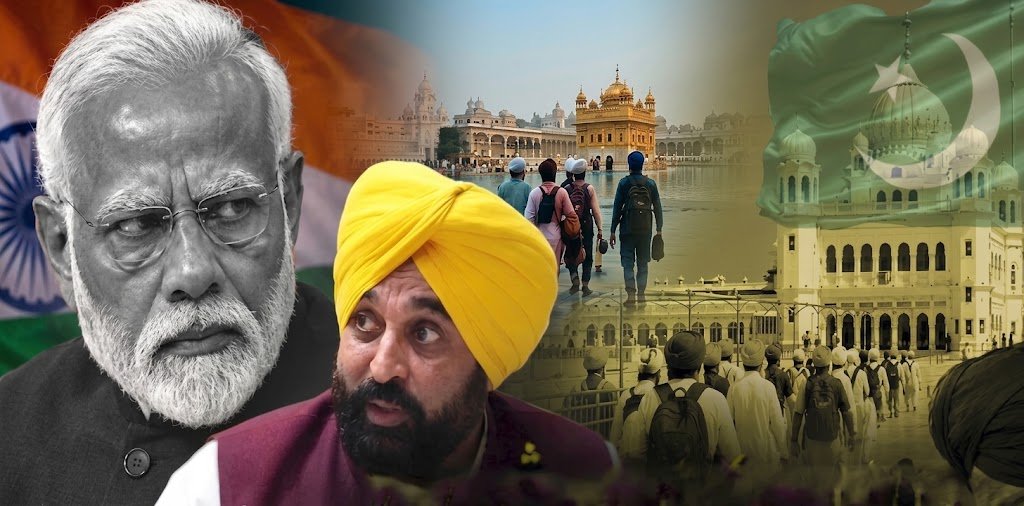
ISLAMABAD: The ongoing restriction on Sikh pilgrims to Pakistan and the continued closure of the Kartarpur Corridor have returned to the spotlight following strong statements from Indian Punjab Chief Minister Bhagwant Mann.
While expressing his desire to attend the upcoming World Punjabi Conference in Lahore, Mann openly questioned the central Modi government’s travel policies and restrictive approach towards cross-border visits.
Addressing the Indian Punjab Assembly, Chief Minister Bhagwant Mann criticized the central authorities, stating that when the Modi government routinely denies him clearance to travel abroad such as his previously barred visits to France and Japan، it remains highly doubtful they will grant permission for his trip to Pakistan.
Echoing these sentiments, the Speaker of the Indian Punjab Assembly and several lawmakers expressed a collective desire to join the delegation to Pakistan.
Mann further urged the Indian government to reopen the Kartarpur Corridor so members of the Assembly could travel to pay homage at the revered Gurdwara Darbar Sahib in Kartarpur and Gurdwara Janam Asthan in Nankana Sahib.
The restriction on Sikh pilgrims to Pakistan has been in place since May 2025 following the Pahalgam security incident.
This prolonged restriction on Sikh pilgrims to Pakistan has severely disrupted religious access for thousands of devotees who wish to visit their holiest sites across the border.
In contrast to New Delhi’s stance, Pakistan’s Ministry of Foreign Affairs reiterated that despite the corridor’s operational shutdown from the Indian side, Pakistan remains fully prepared to welcome all Sikh pilgrims.
BJP’s Rationalism Against Sikhs in India
The ongoing political friction surrounding cross-border travel underscores a broader trend in the ruling Bharatiya Janata Party’s (BJP) ideological framing of national security.
The BJP’s political rationale frequently relies on a hyper-nationalist framework that prioritizes stringent border controls and security-first narratives over religious and cultural freedoms.
Under the guise of counter-terrorism and national integrity, the ruling administration often justifies strict mobility limits on the Sikh community, viewing cross-border religious ties through a political lens rather than one of basic human faith.
By framing Sikh pilgrimages and regional cultural exchanges as national security vulnerabilities, the central government enforces policies that marginalize Sikh religious sentiments.
ALSO READ: Khalistan Referendum in Edmonton: Sikh Community Votes on Independence Demand
Consequently, this state-centric rationale creates persistent friction between New Delhi and the state leadership of Punjab, restricting religious access and straining broader people-to-people contacts.