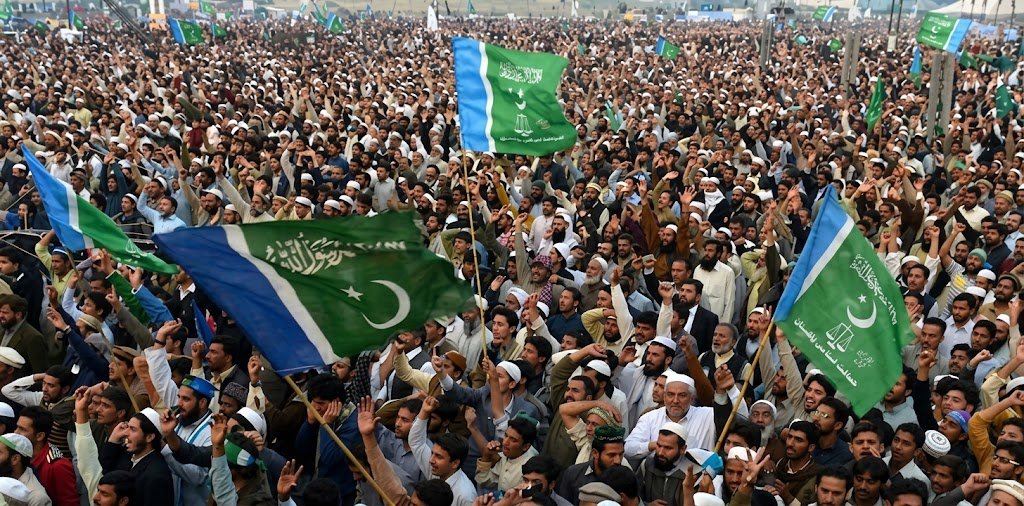
ISLAMABAD: Jamat-e-Islami has threatened to hold a long march against the levy on petroleum by the government.
According to the details, Political tensions have escalated once again as Jamaat e Islami threatens long march over petroleum levy abolition demand, conditional on whether the government provides concrete financial relief to the public.
Talks between the government and Jamaat-e-Islami (JI) are expected to resume within the next 48 hours.
Sources reveal that a key meeting between Prime Minister Shehbaz Sharif and JI Emir Hafiz Naeem ur Rehman is likely to take place this week to discuss issues regarding the removal of the petroleum levy.
Party sources indicated that if substantial relief is not granted, JI will launch a nationwide protest, noting that Jamaat e Islami threatens long march over petroleum levy abolition demand for the final week of October or early November.
Further negotiations with the government remain strictly contingent upon tangible steps toward reducing fuel taxes.
Petroleum Levy in Pakistan
The Petroleum Levy (PL) is a crucial non-tax revenue mechanism utilized by the Federal Government of Pakistan to generate significant revenue from petroleum products, including petrol and high-speed diesel.
Originally introduced to stabilize domestic fuel prices against international market volatility, the levy has evolved into a primary fiscal tool for federal revenue collection and budget deficit reduction.
Under agreements with international financial institutions such as the International Monetary Fund (IMF), Pakistan has progressively raised the petroleum levy cap in recent fiscal budgets to meet strict revenue targets.
While this levy provides essential funding for the national exchequer without requiring direct sharing under the National Finance Commission (NFC) award with provinces, it directly impacts the consumer retail price of fuel.
High petroleum levies contribute to inflation across transport, agriculture, and manufacturing sectors, thereby raising the overall cost of living for middle- and lower-income citizens.
Political parties and civil society organizations frequently demand a reduction or total abolition of the levy to ease the burden of inflation on the public.
ALSO READ: Federal Government Announces Revision in Petroleum Prices
However, balancing public relief with strict macroeconomic stabilization goals remains a complex economic challenge for the government, especially as Jamaat e Islami threatens long march over petroleum levy abolition demand.