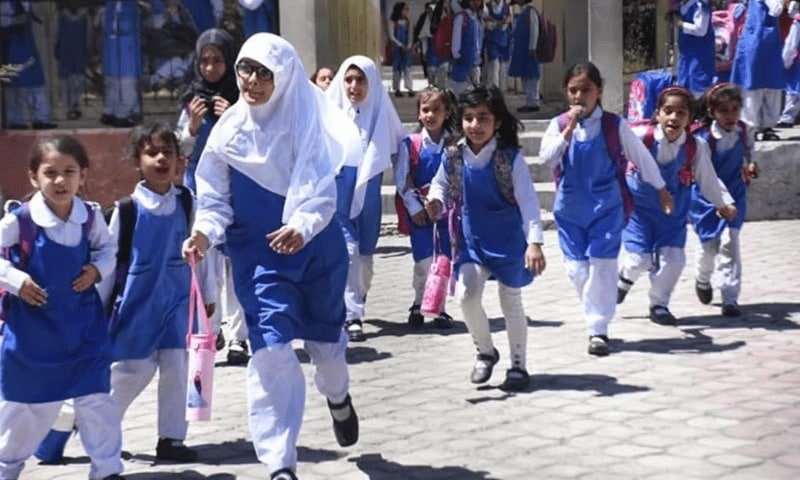
DI KHAN: The government has announced the closure of the private and the government educational institutes and non educational institutions in the DI Khan district.
The matric exams have also been postponed in the District.
According to the sources, after implementing the Governor Rule Emergencies, the KP government has announced the closure of the educational institutes in the DI Khan district.
There will be no matric examination held in DI Khan.
Moreover, the provincial administration has also announced to launch section 144 in the Buner District keeping in view the law and order situation.
It is worth mentioning that the federal government has launched the governor rule in KPK and the provincial government has been terminated.
The sources have claimed the CM KP Sohail Afridi has been arrested on his way to Islamabad during PTI’s long march.
History of Governor’s Rule in Khyber Pakhtunkhwa (KP)
The history of direct central intervention and Governor’s Rule under Article 234 (or constitutional emergency provisions) in Khyber Pakhtunkhwa—formerly known as the North-West Frontier Province (NWFP)—spans several key political and security crises in Pakistan’s parliamentary history.
Key Instances of Direct Federal Rule in KP / NWFP
1. Dismissal of Dr. Khan Sahib’s Ministry (1947)
-
Date: August 22, 1947
-
Context: Immediately following Pakistan’s independence, Quaid-e-Azam Muhammad Ali Jinnah exercised executive authority to dismiss the elected Congress-affiliated provincial government led by Chief Minister Dr. Khan Sahib.
-
Outcome: Executive power was temporarily exercised through Governor Sir George Cunningham before Sir Abdul Qayyum Khan formed a new administration.
2. Governor’s Rule Following Hayat Sherpao’s Assassination (1975)
-
Date: February 17, 1975 – May 3, 1975
-
Context: Following the assassination of PPP leader and Senior Minister Hayat Muhammad Khan Sherpao in a bomb blast at Peshawar University, Prime Minister Zulfikar Ali Bhutto’s federal government suspended the provincial government led by Chief Minister Inayatullah Khan Gandapur.
-
Outcome: The National Awami Party (NAP) was banned, several key leaders were detained, and executive power was placed directly under Governor Major General (Retd) Sayed Ghawas for roughly three months until PPP resumed control.
3. Political Crisis and Constitutional Breakdown (1994)
-
Date: February 25, 1994 – April 24, 1994
-
Context: During Prime Minister Benazir Bhutto’s second term, a major political deadlock erupted when the PML-N and ANP coalition government under Chief Minister Pir Sabir Shah faced defection attempts.
-
Reason: To prevent the collapse of the assembly amidst intense floor-crossing and political horse-trading, President Farooq Leghari, on the advice of the Prime Minister, invoked Article 234 to impose Governor’s Rule.
-
Outcome: Governor Maj Gen (Retd) Khurshid Ali Khan administered the province for two months. The political realignments ultimately allowed PPP’s Aftab Ahmad Khan Sherpao to establish a new majority and assume the office of Chief Minister.
4. Martial Law & Extended Caretaker Eras
In addition to specific Article 234 proclamations, KP has experienced extended periods without elected provincial leadership during broader national military rule:
-
General Zia-ul-Haq Era (1977–1985): Following the 1977 coup, provincial executive power was exercised directly through Martial Law Administrator/Governor Lt. Gen. Fazle Haq for over seven years.
-
General Pervez Musharraf Era (1999–2002): Following the October 1999 coup, provincial assemblies were suspended, placing KP under military-appointed governors (Lt. Gen. Mohammad Shafiq and Lt. Gen. Iftikhar Hussain Shah) until general elections restored political government in late 2002.
- ALSO READ: Federal Government Took a Difficult Move: Mohsin Naqvi
Constitutional Provisions Governing Emergency Declarations
Under Article 234 of the Constitution of Pakistan:
-
The President can issue a proclamation assuming provincial functions if satisfied, on a report from the Governor or otherwise, that a situation has arisen where the government of the province cannot be carried out in accordance with the Constitution.
-
Any proclamation must be approved by a joint sitting of Parliament within two months to remain valid beyond that period.