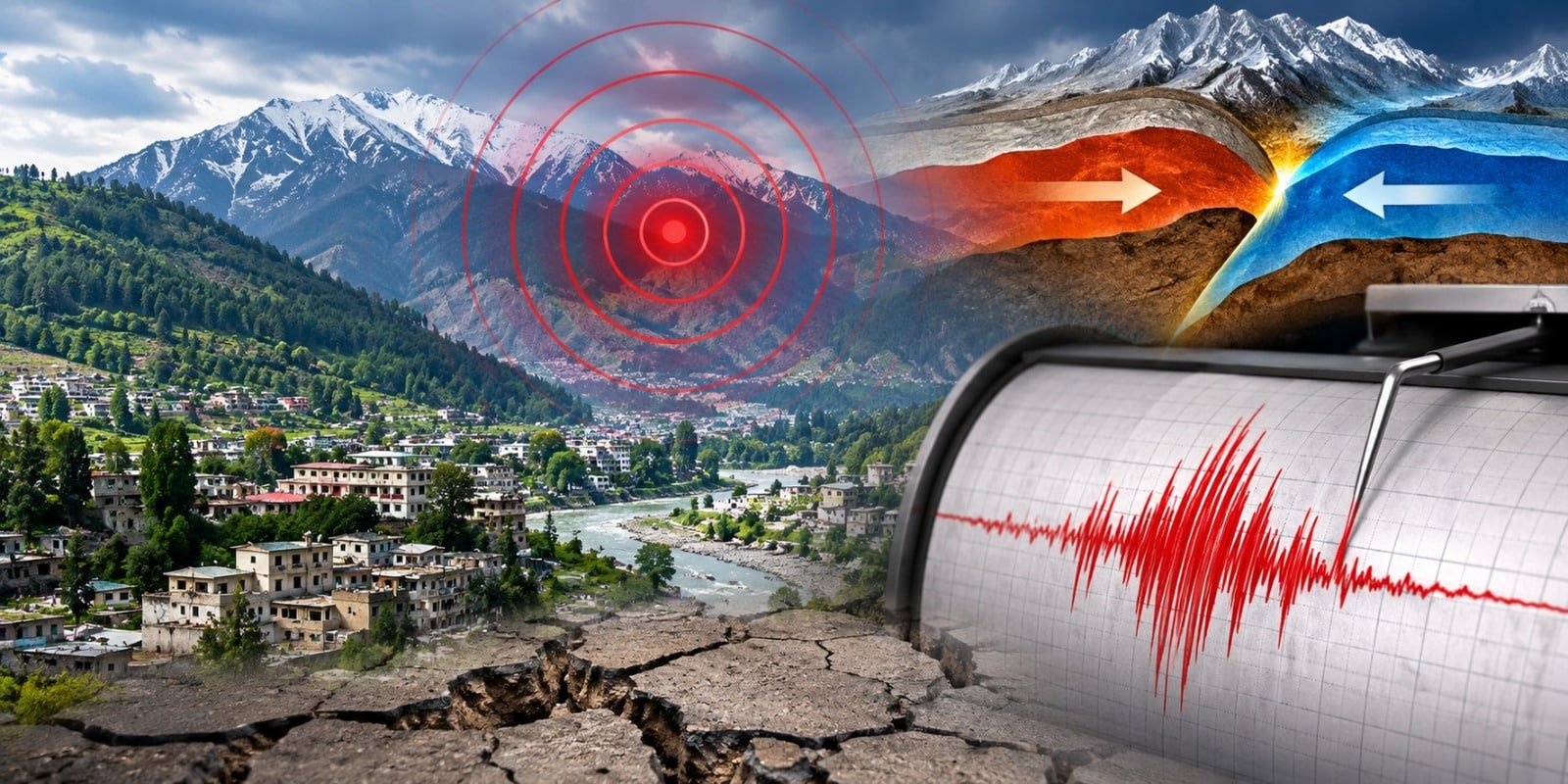
SWAT: An earthquake measuring 4.6 on the Richter scale jolted Swat and surrounding areas on Wednesday, sending residents rushing out of their homes and buildings in fear.
According to the Pakistan Meteorological Department’s Seismic Monitoring Centre, the earthquake was recorded at a depth of 182 kilometres beneath the Earth’s surface, with its epicentre in the Hindu Kush mountain range.
Residents felt tremors across Swat and nearby areas, prompting people to leave their homes and buildings while reciting prayers and the Kalima.
However, there were no immediate reports of casualties or property damage. Local authorities and relevant departments were monitoring the situation.
Why is the Hindu Kush region prone to earthquakes?
The Hindu Kush mountain range is among the world’s most seismically active regions, particularly because of the ongoing collision between the Indian and Eurasian tectonic plates.
As the Indian plate moves northward and pushes against the Eurasian plate, immense geological pressure builds beneath the Earth’s crust. This collision has contributed to the formation of the Himalayas, Karakoram and Hindu Kush mountain systems while generating frequent seismic activity across the region.
Unlike many earthquake-prone areas, the Hindu Kush is also known for unusually deep earthquakes. Scientists have recorded seismic events hundreds of kilometres beneath the Earth’s surface, linked to the movement, stretching and sinking of the Indian lithosphere beneath the region.
A 2019 study published in the journal Tectonics described the Hindu Kush as one of the world’s most seismically active zones at intermediate depths, particularly between 70 and 300 kilometres underground.
Similarly, research published in Geophysical Research Letters in 2016 found that major deep earthquakes in the Hindu Kush have historically recurred at intervals of approximately 10 to 15 years, with scientists linking the phenomenon to the stretching and downward movement of a sinking slab of lithosphere.
Are earthquakes becoming more frequent in northern Pakistan?
A 2016 study published in the journal Natural Hazards examined earthquake records from northern Pakistan between 1965 and 2004 and reported a gradual increase in the frequency of earthquakes measuring between 4.1 and 5.0 magnitude.
The researchers suggested that changes in rainfall, glacier mass and sediment movement could potentially influence local stress conditions along geological faults.
However, the study does not establish that climate change is causing a sustained increase in earthquakes across the region. Nor does it establish that the recent tremors in Swat represent a new seismic trend.
The Hindu Kush and adjoining northern Pakistan remain naturally earthquake-prone because of their complex tectonic setting, making continuous seismic monitoring and preparedness essential.