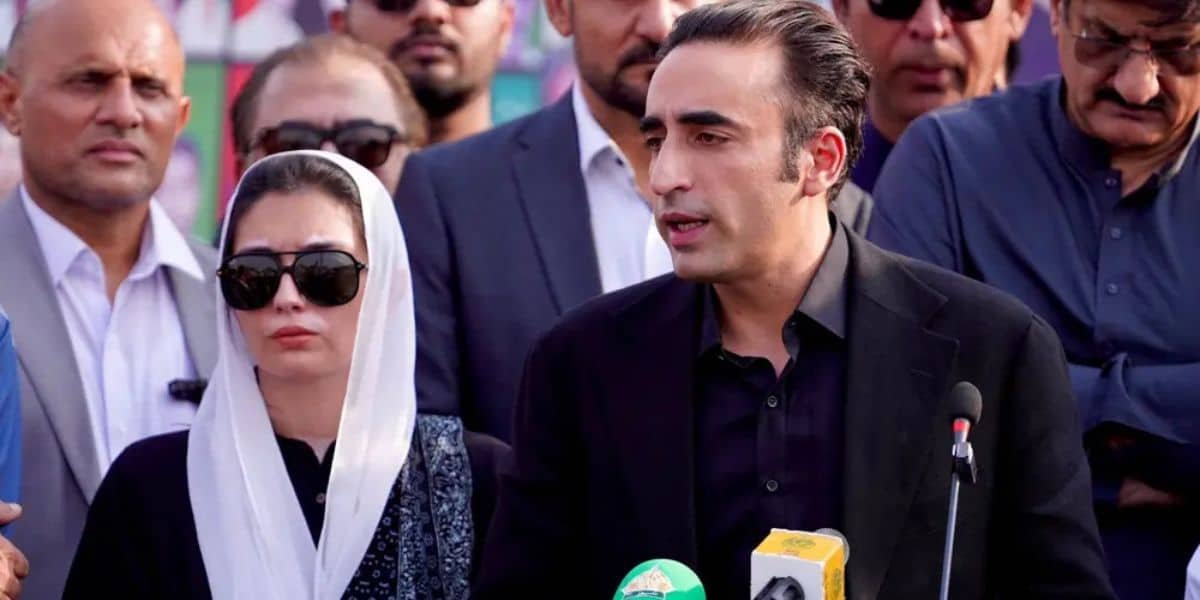
KARACHI: Pakistan Peoples Party (PPP) Chairman Bilawal Bhutto-Zardari has said that KP Governor’s Rule Could End if Opposition Cooperates on Counterterrorism, adding that political parties must engage with the federal government and develop a unified strategy to combat militancy in Khyber Pakhtunkhwa.
Speaking to the media in Karachi on Sunday during a visit to the Karsaz Monument to mark the 19th anniversary of the Karsaz bombing, Bilawal invited opposition parties, particularly Pakistan Tehreek-e-Insaf (PTI), to cooperate with the Centre on counterterrorism efforts.
He said governor’s rule and the emergency imposed in the province could be lifted if political parties reached an agreement on a coordinated strategy to address the security situation.
“If they really want to fight terrorists, and if they want that emergency and governor’s rule in KP to end, they should engage with the federal government and politicians and discuss a united policy regarding the fight against terrorism,” Bilawal said.
The federal government reportedly imposed governor’s rule and an emergency in Khyber Pakhtunkhwa a week earlier, citing concerns over the provincial government’s approach to counterterrorism. The move came amid heightened political tensions surrounding PTI protests and demands for the release of the party’s incarcerated founder, Imran Khan.
KP Governor’s Rule Could End if Opposition Cooperates on Counterterrorism
Bilawal defended the federal government’s position, arguing that political consensus and coordinated action were necessary to address the province’s worsening security challenges.
He criticised KP Chief Minister Sohail Afridi over what he described as an unwillingness to confront terrorist groups. Bilawal added that the PPP was ready to work with political forces committed to combating militancy.
The PPP chairman said his party would cooperate with all stakeholders willing to contribute to counterterrorism efforts, stressing that the threat of terrorism required a collective national response.
He also pointed out that militant violence was not limited to Khyber Pakhtunkhwa, referring to attacks in different parts of the country, including Khyber and Khuzdar.
Bilawal expressed concern over the resurgence of militant activity and referred to policy decisions taken after the Taliban returned to power in Afghanistan in 2021. He criticised the previous government’s approach towards the repatriation and resettlement of members of the banned Tehreek-e-Taliban Pakistan (TTP), arguing that Pakistan was now facing the consequences of those decisions.
He also recalled the release of militants previously held in Pakistani prisons, saying that past policy choices had contributed to the country’s security challenges.
Bilawal Calls for National Unity Against Terrorism
Referring to the Karsaz bombing, Bilawal said a major setback in Pakistan’s fight against terrorism had been the failure to take certain incidents and their implications seriously.
He recalled the PPP government’s counterterrorism efforts during its 2008–2013 tenure, saying the party had worked to build public support for security operations and subsequently supported institutional reforms under the National Action Plan (NAP).
According to Bilawal, sustainable progress against terrorism requires the participation of citizens, political parties, law enforcement agencies and security institutions.
He called for renewed national consensus on counterterrorism and said the PPP had advocated a new National Action Plan to respond to evolving security threats.
The PPP chairman also urged politicians not to turn counterterrorism measures into another source of political confrontation, stressing that national security demanded collective responsibility.
Bilawal Warns of Economic Challenges, Calls for Electoral Reforms
Bilawal warned that Pakistan was facing a serious economic crisis and said the situation could worsen without effective and timely measures.
He argued that tackling terrorism was essential to addressing the country’s wider challenges, including economic instability. He also called for improvements to the democratic and electoral systems.
According to Bilawal, the federal government had decided to establish an electoral reforms committee in the National Assembly. He invited opposition parties to participate in the process.
He said political forces concerned about weaknesses in the democratic system should contribute to strengthening it through dialogue and meaningful reforms.
Responding to questions about political compromises, Bilawal said negotiations were a normal part of politics. Referring to the political legacy of former prime minister Benazir Bhutto, he argued that dialogue and compromise had helped resolve major national issues and advance constitutional democracy.
He maintained that the PPP would continue to work within the parliamentary and political framework despite not being part of the federal government.
Bilawal Explains PPP’s Position on New Provinces
Addressing the debate over the creation of new provinces or administrative units, Bilawal said any such changes must comply with the Constitution and the law.
He maintained that new provinces could be established where there was clear political consensus and support from the relevant provincial assembly, rather than through political manoeuvring.
Bilawal referred to Gilgit-Baltistan as an example of a region where constitutional rights had received support through a legislative assembly resolution.
The PPP chairman also reiterated his party’s opposition to proposals that could divide Sindh, where the party governs. The Sindh Assembly recently adopted a resolution opposing attempts to divide the province or establish new administrative units.
Bilawal Urges Dialogue Between Government and Opposition
Bilawal said political differences should not prevent cooperation on issues affecting national security and democratic stability.
Commenting on Jamiat Ulema-e-Islam-Fazl (JUI-F) chief Maulana Fazlur Rehman, he acknowledged his right to criticise government policies while urging him to condemn terrorist violence.
Bilawal also noted that the PPP had previously supported emergency measures imposed on constitutional and legal grounds, including governor’s rule in Balochistan during its own period in government.
Also Read: Pakistan Standing with Saudi Arabia Like a Rock Amid Houthi Attacks, Khawaja Asif Says
He argued that political parties should be prepared to make difficult decisions in the national interest, even when those decisions could affect their own political standing.
Concluding his remarks, Bilawal expressed hope that dialogue among the federal government, opposition parties and other political stakeholders would help build consensus on counterterrorism and improve political stability across Pakistan.