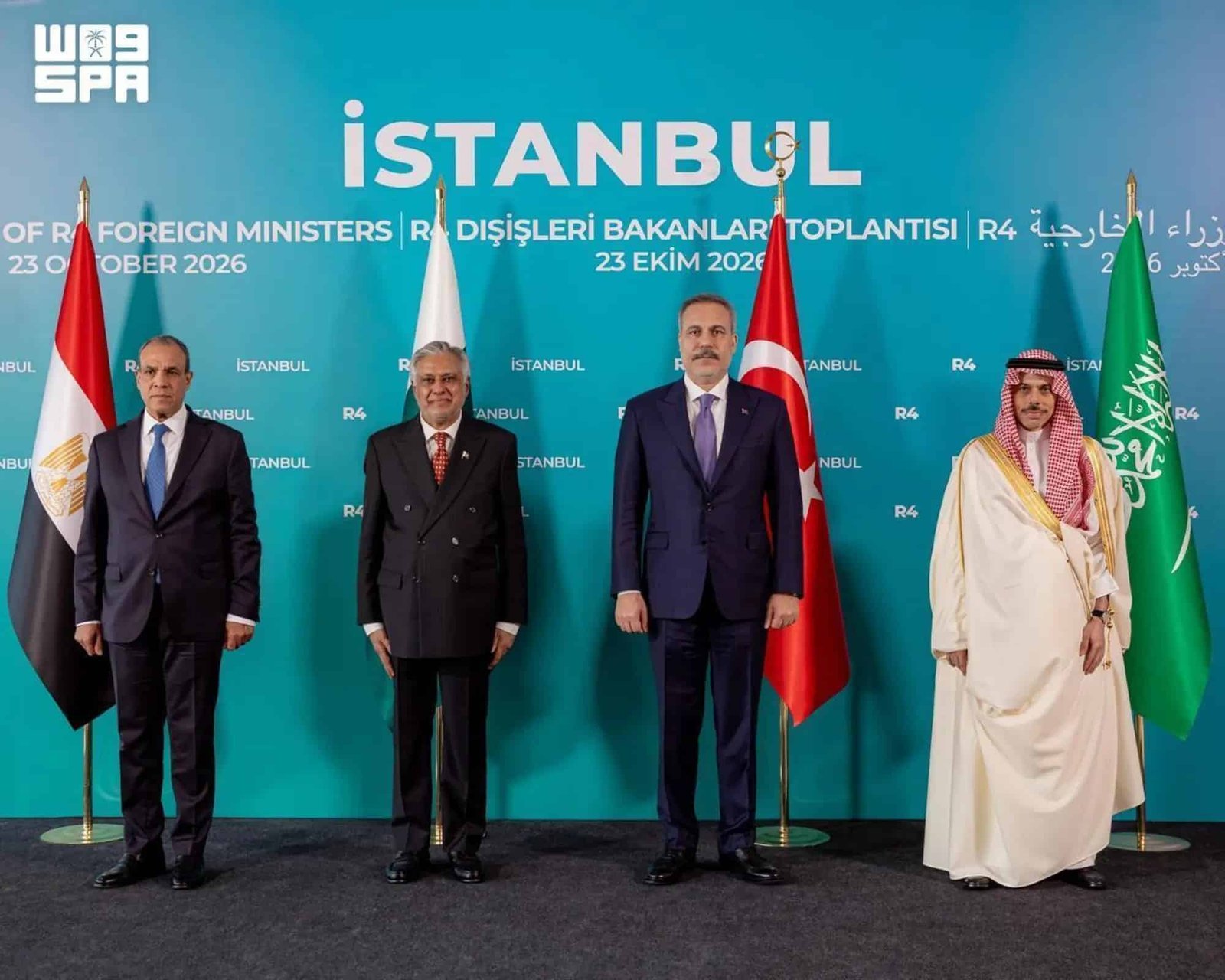
ISLAMABAD: Pakistan and seven other countries have called for urgent diplomatic engagement to address regional conflicts, warning through a joint statement of the security, economic and trade challenges linked to continuing tensions.
According to a statement issued by the Foreign Office on Saturday, foreign ministers meeting in Istanbul reaffirmed their commitment to dialogue, diplomacy and de-escalation as essential steps towards lasting peace and stability.
The October 23 gathering brought together the R4 countries — Pakistan, Turkiye, Egypt and Saudi Arabia — alongside France, Germany, Italy and the United Kingdom.
The ministers discussed the United States-Israel-Iran conflict, the Israeli-Palestinian conflict and the need for a negotiated two-state solution.
Their discussions also covered Houthi attacks against Saudi Arabia and Yemen’s government, maritime security and mounting tensions around strategically important waterways.
The statement identified the Strait of Hormuz, Bab el-Mandeb and the Black Sea among the areas requiring attention, placing freedom of navigation alongside broader regional security concerns.
The agenda reflected shared concern over how multiple conflicts and maritime tensions could affect stability, economic activity and international trade.
Participants agreed that regional disputes required urgent attention through dialogue and diplomatic engagement, with de-escalation forming a central part of their collective approach.
They stressed the importance of lasting, negotiated settlements in accordance with relevant United Nations resolutions.
On the Israeli-Palestinian conflict, the ministers highlighted the need for a negotiated two-state solution, keeping a political settlement central to their discussions.
The statement outlined a common diplomatic position and a commitment to continued engagement. It did not announce a comprehensive settlement of the conflicts discussed.
Safety and freedom of navigation featured prominently as ministers examined the wider consequences of regional tensions.
They committed to supporting diplomatic efforts addressing the security, economic and trade implications of these challenges, extending the discussion beyond immediate military developments.
Their inclusion of several maritime flashpoints underscored the breadth of the meeting’s agenda and the importance participants attached to reducing tensions through cooperation.
Pakistan Continues R4 Engagement
Deputy Prime Minister and Foreign Minister Ishaq Dar also attended the sixth R4 foreign ministers’ meeting with his Turkish, Egyptian and Saudi counterparts.
The group reviewed developments in the Middle East and discussed regional security challenges and conflicts.
ALSO READ: Achakzai Warns of Full-Scale War; With Taliban After Istanbul Talks Fail
Established in March, the R4 framework has focused on regional security and mediation between Washington and Tehran.
Ministers agreed to continue the expanded dialogue to help prevent conflicts.