ISLAMABAD: FIA has filed FIR against the Pakistanis deported from Turkey over work violations.
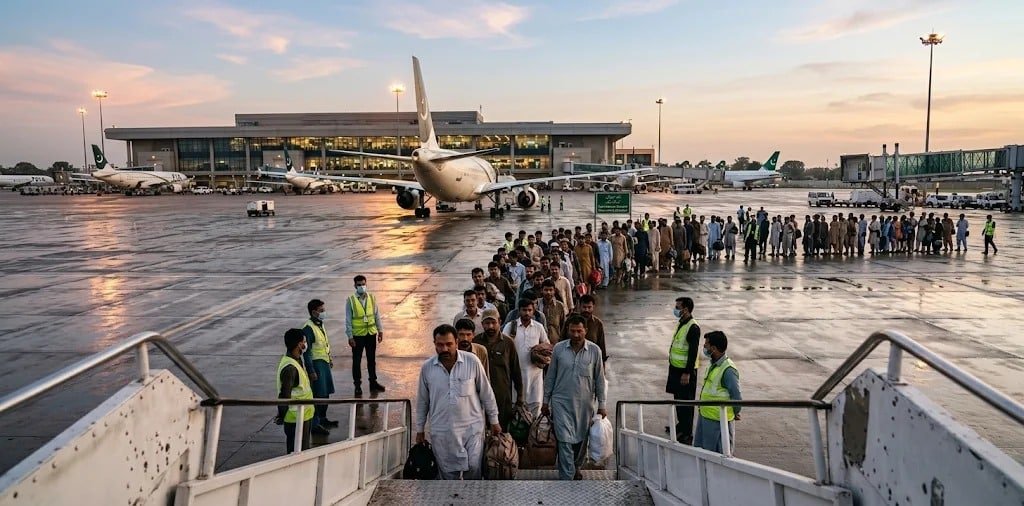
According to the details, the Federal Investigation Agency (FIA) Immigration unit in Islamabad has formally registered cases against eight Pakistani citizens who were deported from Turkey for violating the terms of their work visas.
According to initial investigations, these individuals had traveled to Turkey on legal work visas with specific companies.
However, instead of taking up the employment for which their visas were issued, they allegedly engaged in illegal work at other locations.
This breach of visa conditions led to their arrest by Turkish police and subsequent imprisonment.
Following their jail term, the Turkish authorities deported from Turkey the eight individuals.
Upon their arrival in Islamabad, the FIA took action, booking the suspects under Sections 3 and 4 of the Passport Act, 1974.
These sections specifically deal with visa violations and entry into a foreign country contrary to the provisions of the act or visa conditions.
An FIA spokesperson stated that the investigation is now focused on the facilitators and agents involved.
The degree of involvement of these individuals or agencies, who might have misled the workers or facilitated their illegal employment, will be determined during the ongoing probe into those deported from Turkey.
Turkey’s Policies for Work Permit Visas for Foreigners
Turkey maintains a comprehensive and structured legal framework for regulating foreign employment, primarily governed by the International Labor Force Law (No. 6735).
This law mandates that all foreigners wishing to work in Turkey, including those seeking a Turkey work permit visa, must obtain prior authorization before commencing any employment activity.
The key characteristic of the Turkish system is its strong employer-driven approach. Work permit applications are typically initiated jointly by the foreign employee and the Turkish employer.
The employer must submit the application to the Ministry of Labor and Social Security, while the employee simultaneously applies for a work visa at a Turkish consulate in their home country.
The approval process is rigorous. The Ministry evaluates applications based on several criteria, including labor market needs, economic conditions, and whether the job can be filled by a Turkish citizen.
Furthermore, employers must meet specific requirements, such as a minimum capital investment and a ratio of employing at least five Turkish citizens for every one foreign employee, particularly for first-time applicants.
Crucially, a Turkey work permit visa is always issued for a specific employer, job, and duration.
For the first application, the permit is usually granted for one year and is employer-specific. Subsequent renewals can extend the duration and, in some cases, provide limited mobility, but the employer-specific restriction generally remains until a permanent work permit is acquired after long-term legal employment.
Violating these conditions, such as working for an unauthorized employer or outside the specified occupation, constitutes a serious legal offense.
Passports of deported beggars to be blocked: Salik Hussain
Such breaches frequently lead to the cancellation of the permit, immediate termination of employment, significant fines, arrest, and deportation, carrying long-term entry bans into Turkey.