MIAMI: Two planes collide on airport in US causing injuries to two persons.
According to the sources, just a day after a nationwide temporary ground stop on flights across the United States, a runway collision occurred on Saturday night when two aircraft collide on Miami International Airport runway leaving two injured.
According to the Federal Aviation Administration (FAA), a Copa Airlines Boeing 737 aircraft while taxiing on the runway struck the nose section of a UPS cargo Boeing 767 aircraft.
Miami International Airport Director of Communications Greg Chen informed CNN that the collision, which occurred at approximately 9:15 PM local time, resulted in minor injuries to two individuals. Fire and rescue teams promptly provided medical assistance to the victims at the scene.
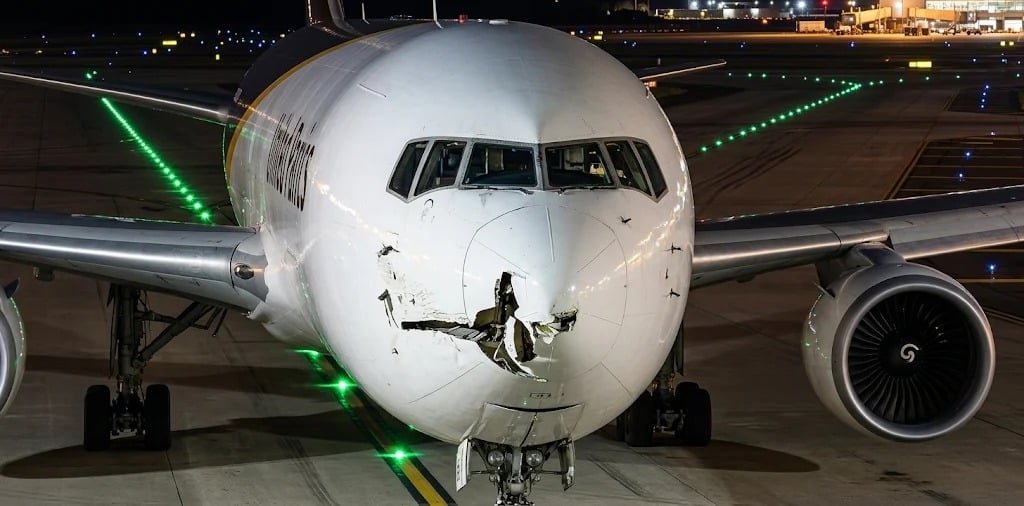
Photographs released after the incident show visible damage to the nose section of the UPS cargo plane, featuring a large crack in its panels.
Reports indicate that the Copa Airlines flight had just arrived in Miami from Panama City, whereas the UPS cargo plane was preparing for departure toward Bogotá, the capital of Colombia.
This unfortunate accident unfolded as airports nationwide were striving to restore normal flight operations following Friday’s widespread FAA flight suspension, underscoring ongoing safety concerns as two aircraft collide on Miami International Airport runway leaving two injured.
Overview of Aviation and Plane Crash Incidents in 2026
The year 2026 has witnessed several notable aviation incidents, accidents, and near-misses globally, prompting renewed scrutiny over air traffic control procedures, runway safety, and equipment reliability.
While commercial aviation remains statistically one of the safest modes of transportation, a series of runway incursions, technical malfunctions, and severe weather-related mishaps have kept aviation authorities on high alert.
Regulatory bodies such as the Federal Aviation Administration (FAA) and the International Civil Aviation Organization (ICAO) have continuously emphasized the implementation of advanced ground surveillance systems, mandatory safety protocols, and rigorous pilot-controller communication training to mitigate collision risks at busy international hubs.
In response to recent incidents, airlines and airport operators worldwide have ramped up investments in automated runway status lights, surface detection equipment, and pilot assistance technologies.
Despite these proactive measures, unexpected mechanical failures, human errors, and unprecedented airspace congestion continue to pose challenges for aviation safety management teams.
ALSO READ: Devastating Florida Learjet 60 Plane Crash Kills All 9 Aboard Near Mar-a-Lago
Experts stress that maintaining rigorous adherence to safety standards and upgrading aging airport infrastructure are vital steps in preventing similar runway mishaps and ensuring passenger confidence in global air travel networks.