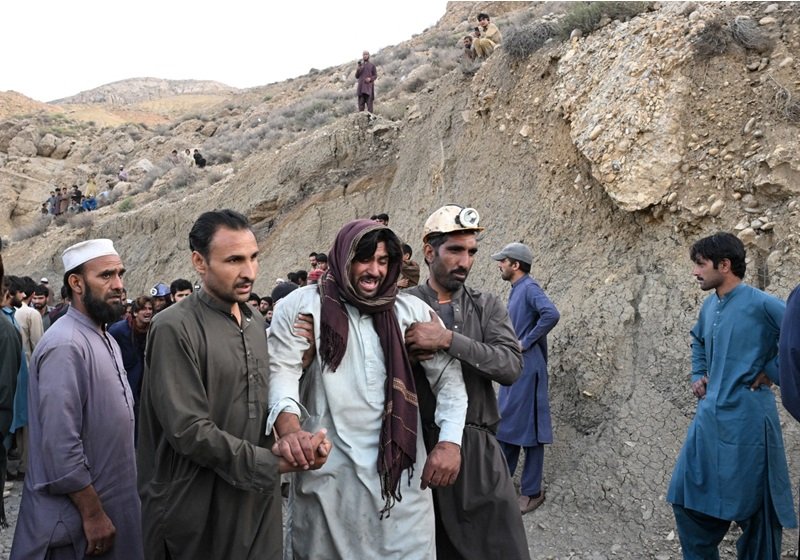
QUETTA: An inquiry into a coal mine disaster that killed 34 workers near Quetta has found that illegal use of explosives triggered the blast, while investigators also discovered that the mine employed workers as young as 16.
The high-level inquiry committee, headed by Balochistan Chief Minister’s Inspection Team Chairman Bashir Ahmed Bangulzai, has recommended criminal proceedings against the mine owners, management and officials of the Pakistan Mineral Development Corporation (PMDC).
The disaster occurred on July 30, 2026, at the Sor Range coalfield, about 30 kilometres southeast of Quetta.
Chief Minister Sarfraz Bugti ordered the investigation after the incident. The committee, which also included Muhammad Zaman Bazai and Muhammad Ilyas, visited the site, recorded statements from officials and examined evidence and documents before completing its report nearly two months later.
How the blast happened
According to the inquiry report, the explosion occurred at about 2:30 p.m. during the second shift at Mine No. 1 of the Sardar Muhammad Usman Khan Jogezai Coal Company.
The blast occurred about 4,180 feet underground.
Mine Nos. 1 and 2 were connected for ventilation and airflow, causing both workings to be affected. Mine No. 1 completely collapsed, damaging its entrance and ventilation system.
At the time, 32 miners were working in the two mines. Only one escaped alive.
Three more workers later entered the mine to rescue colleagues and relatives, despite safety and rescue protocols. They also died.
The recovery operation took about three days. Medical examinations found that five miners died from burns, while 29 died from suffocation.
Illegal explosives identified as main cause
The inquiry identified the illegal use of explosives as the primary cause of the disaster.
Citing findings from the Mines Department’s court of inquiry, the committee said the explosion occurred at the longwall face, where coal was being extracted.
Investigators found a hard rock layer between a seven- to eight-foot coal seam and discovered drill holes in the rock, indicating that blasting had taken place.
The report said the blasting generated fine coal dust that may have travelled toward the entrance of the mine and contributed to the deadly explosion.
The court of inquiry concluded that the disaster resulted from the illegal use of explosives and negligence by the mine management.
The owner, manager and mine supervisor were aware that underground blasting was taking place but allegedly ignored it and failed to inform the authorities, the report said.
The inquiry also found violations of Rules 97 and 99 of the Coal Mines Regulations, 1926, which govern the use and storage of explosives.
Under the regulations, explosives can be used in coal mines on a limited basis, but only with the required licence and a qualified expert.
Mines Inspectorate officials told Urdu News that the company had neither a licence nor a qualified expert to use explosives.
Six miners were under 18
The inquiry also found that six of the victims were under 18, including two who were younger than 17.
One was 16 years and three months old, while another was 16 years and four months old.
The Mines Act, 1923, prohibits the employment of anyone under 17 inside a mine.
The disaster also claimed the lives of three brothers and their uncle. The report listed six other victims belonging to three separate families.
The committee recommended legislation to prevent brothers and close relatives from working in the same shift, although current law does not prohibit relatives from doing so.
Criminal proceedings recommended
The inquiry committee recommended criminal proceedings under the Mines Act, 1923, and Coal Mines Regulations, 1926, against PMDC’s managing director as well as the owners and management of Sardar Muhammad Usman Khan & Company.
Those named include company partners Sheikh Muhammad Azim, Sardar Ali Ahmed Jogezai, Wazir Ahmed Jogezai, Iftikhar Ahmed Jogezai and Khurshid Ahmed Jogezai.
The report also named Managing Director Sardar Qurban Ali Jogezai, Manager Akhtar Shahzad and Mine Supervisor Muhammad Gulab.
The committee declared the manager and mine supervisor unfit to perform their duties.
It said the mine supervisor could not personally record pre-shift inspection details and instead relied on a timekeeper.
The committee questioned how the supervisor could properly check and record gas-detector readings under such circumstances.
PMDC accused of illegal subcontracting
The report also raised serious questions about PMDC’s role.
PMDC held the lease for the mining area but allowed the company to operate as a “rising contractor” under an agreement covering 282 acres.
Under the arrangement, the company paid PMDC a royalty of Rs1,230 per tonne.
The agreement placed responsibility for compliance with mining laws and compensation in case of an accident on the contractor. It also sought to shield PMDC from liability, according to the report.
However, the inquiry committee said such a contracting arrangement had no legal basis.
It argued that leasing a mining area and subsequently handing operations to another party did not absolve the leaseholder of its responsibility for workers’ safety.
The committee said PMDC had allowed at least 15 contractors to operate in violation of Section 55(5) of the Balochistan Mines and Minerals Act, 2025.
Too few inspectors to monitor thousands of mines
The inquiry also highlighted a severe shortage of inspectors.
Balochistan has 2,935 mines but only 15 inspection officers, the committee said.
In the region where the disaster occurred, just one inspector, one junior inspector and one electrical inspector oversee 507 mines and about 6,000 miners.
The committee said the staffing shortage made it impossible for an inspector to revisit even the same mine once a year.
It recommended restructuring the Mines Inspectorate, improving its technical capacity and studying safety systems in other provinces to develop a workable model for Balochistan.
The committee also called for tighter controls over the sale and use of explosives in mines and a review of all subcontracting agreements, with illegal arrangements to be cancelled and action taken under the law.
It further recommended expediting the Mines Health and Safety Bill 2026, saying the century-old Mines Act was inadequate for current safety requirements.
Earlier inspections raised safety concerns
The Mines Department also conducted a separate investigation after the disaster.
Three officials, including a mines inspector, were suspended for alleged negligence.
The Labour Department separately inspected the site and reported that the mine had no labour union and that the company did not allow workers to form one.
Workers were living in poor conditions and lacked clean drinking water, the report said.
Inspectors were also unable to verify registration of workers with the Employees’ Old-Age Benefits Institution (EOBI). The company later produced registration records for only 14 of the 34 victims.
The company had also failed to make the mandatory two-percent contribution to the Workers Welfare Board, which provides financial assistance and scholarships to workers and their children.
The Labour Department recommended increasing compensation paid by the owners to each victim’s family from Rs500,000 to Rs2 million.
Questions over “paper compliance”
Documents obtained by activist Aun Ali under the Right to Information law show that the Chief Inspector of Mines had said the affected mine was not sealed as unsafe before the disaster.
The documents show that the Mines Inspectorate had inspected four mines operated by the company before the accident.
The two affected mines were initially declared satisfactory in terms of safety arrangements. However, inspectors found ventilation problems, toxic gases, coal dust and inadequate wooden supports at Mines No. 3 and 6 and issued show-cause notices and ordered work stopped there.
During inspections of Mines No. 1 and 2 on June 10, inspectors found violations including the absence of pre-shift inspections, inadequate wooden supports and failure to remove coal dust. The company was issued a warning.
On June 26, the company manager claimed that all violations had been addressed.
Thirty-four days later, the disaster struck.
Aun Ali questioned why inspectors had failed to detect evidence of drilling and explosive use when other violations had already been identified.
He suggested that the inspectorate appeared to have been satisfied with paperwork rather than ensuring actual compliance on the ground.
The Mines Inspectorate, however, disputed that assessment, saying its inspection about 50 days before the accident had not found any serious violation in the affected mines and that normal coal extraction continued until the disaster.
Case registered against mine management
A case was registered against the mine owners, manager and mine supervisor under Section 322 of the Pakistan Penal Code, relating to causing death by negligence.
Officials said the suspects secured bail before their arrest and therefore were not taken into custody.
Hundreds killed in Balochistan coal mines
Balochistan has extensive coal reserves in Quetta, Kachhi, Harnai, Loralai and Dukki, among other districts.
The coal is supplied to brick kilns, cement factories and power plants across Pakistan. Thousands of miners work in the province’s coalfields, many of them from Swat, Shangla and other parts of Khyber Pakhtunkhwa.
Of the 34 miners killed in the Sor Range disaster, 33 were from Shangla, with most belonging to the same village.
Mines Inspectorate data show that 458 miners have died in 268 accidents in Balochistan’s coal mines since 2021.
So far this year, 75 miners have died in 35 accidents, according to the data.
A Human Rights Commission report has said more than 100 miners die every year on average because of inadequate safety measures.
Profit versus workers’ safety
The inquiry report said the company extracted more than 68,000 tonnes of coal from four production mines during the previous three financial years and paid about Rs8.9 million in royalties.
Workers’ representatives say coal from the area is among the most expensive in Balochistan, selling for more than Rs30,000 per tonne.
At that rate, more than Rs2 billion worth of coal was extracted during the three-year period, according to the figures cited by labour representatives.
Lala Sultan Khan, secretary-general of the Pakistan Central Mines Labour Federation, said the figures showed that mine owners and companies were prioritising profits over workers’ safety.
“Miners are paying with their lives for coal extraction,” he said, urging the government to take strict action against those held responsible in the latest investigations.
He said hundreds of workers continued to die in mining accidents every year and recalled that more than 50 miners were killed in a single accident about a decade ago, with those responsible still not punished.
The inquiry committee said underground mining remained one of the world’s most dangerous occupations and stressed that stronger enforcement, effective inspections and compliance with safety laws were essential to protect miners’ lives.