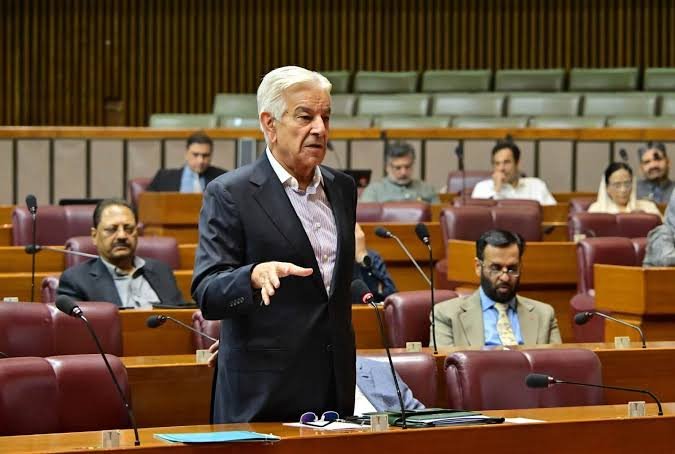
ISLAMABAD: Defence Minister Khawaja Asif has questioned Maulana Fazlur Rehman’s offer to help facilitate negotiations involving Iran, challenging the Jamiat Ulema-e-Islam-Fazl (JUI-F) chief to reflect on his own political record while defending Field Marshal Asim Munir’s diplomatic efforts in Tehran.
Speaking in the National Assembly, Asif said Munir had travelled to Tehran to promote regional peace and facilitate reconciliation between the parties, not to negotiate a defence agreement or discuss Pakistan’s defence affairs.
The defence minister said the field marshal had played an important role in promoting peace and dialogue for Pakistan following the conflict that began last year. He added that the diplomatic activities in Tehran were separate from existing defence arrangements.
Asif said Pakistan and Saudi Arabia had already concluded a defence agreement, while he also referred to defence agreements involving Qatar, Türkiye, Pakistan and Indonesia. He stressed that the Tehran initiative was aimed at easing tensions and creating space for regional peace.
Khawaja Asif Questions Fazlur Rehman’s Political Record
Turning to Fazlur Rehman, Asif said the JUI-F chief held a place in Pakistan’s political history and acknowledged the significance of his father. However, he argued that political leaders should remember their own past decisions and positions when criticising others.
Asif questioned the context in which Fazlur Rehman had offered his services to facilitate negotiations involving Iran. He also referred to the JUI-F chief’s participation in the political system during former military ruler General Pervez Musharraf’s government and his tenure as chairman of the parliamentary Kashmir Committee.
The defence minister challenged Fazlur Rehman to explain what he had achieved for the Kashmir cause during his time leading the committee.
Asif also acknowledged his own political past, saying he had supported the government of former military ruler General Zia-ul-Haq but later apologised for his position in light of subsequent developments.
He said political leaders should not consider themselves beyond criticism and should be prepared to answer questions about their own decisions.
Religion and Politics: Asif Calls for Political Tolerance
Addressing the religious dimension of Fazlur Rehman’s politics, Asif said the JUI-F chief’s political approach revolved around religious positions, describing this as his political method.
However, Asif argued that other political parties also had the right to make decisions according to their circumstances and political interests. His remarks suggested that religious differences should not be used to undermine the legitimacy of other parties’ political choices.
The defence minister also called for greater tolerance and mutual respect among political leaders, saying disagreements should not be expressed in ways that damage political dignity.
He noted that rival parties had cooperated in the past and had even shared power in coalition governments. Political differences, he argued, should not prevent leaders from acknowledging one another’s contributions.
Asim Munir’s Diplomacy and Pakistan’s Regional Role
Asif urged political leaders to recognise Pakistan’s international role and Munir’s efforts to promote regional peace, despite their domestic political differences.
He also referred to changing political alignments, pointing to decisions by different parties based on their political interests and circumstances, including developments involving Pakistan Tehreek-e-Insaf (PTI) lawmakers.
His remarks placed the debate over Munir’s Tehran visit within a wider argument about political consistency, religious identity and the need for mutual respect among Pakistan’s political leadership.