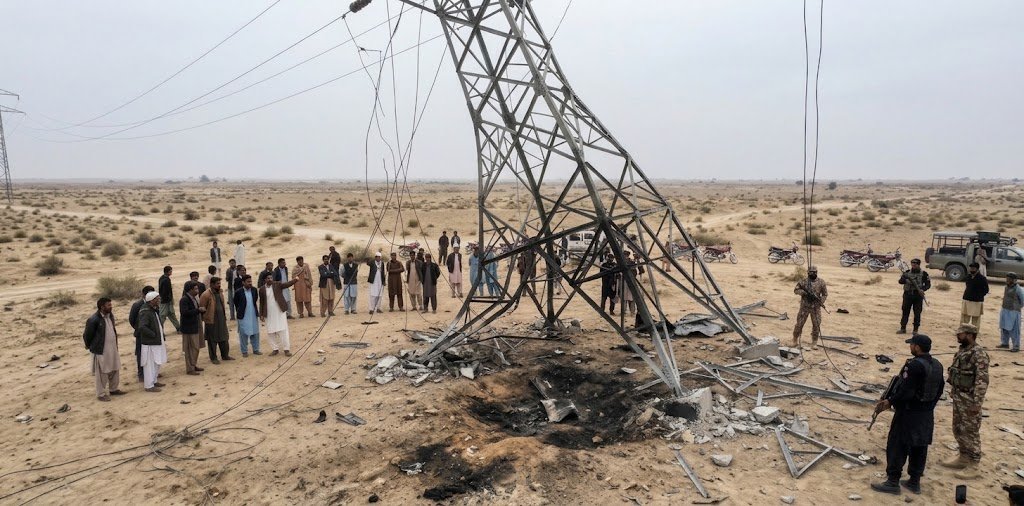
QUETTA: BLA terrorists destroy 11,000-volt power transmission tower in the Manjhoshori area of Balochistan, executing a targeted explosive attack that severely disrupted the electricity supply to local residents.
According to the sources, Security officials reported that the sabotage directly aimed at critical public utilities, leaving large communities without power and interrupting everyday life across the region.
As emergency repair crews work alongside local authorities to restore the high-voltage line, security forces have launched a search operation to track down the perpetrators of this criminal act.
The systematic targeting of public utilities highlights a persistent pattern where BLA terrorists destroy 11,000-volt power transmission tower components and other basic facilities to instill panic. By undermining basic services, the militant network inflicts severe hardship on ordinary civilians, preventing essential access to electricity, water, and healthcare facilities.
Targeting critical infrastructure directly harms ordinary civilians, depriving communities of essential services, stalling local economic activity, and frustrating community efforts toward regional progress.
As law enforcement secures the surrounding perimeter, engineers are working under high-security protocols to rebuild the grid structure.
Regional stakeholders have strongly condemned the act, emphasizing that community stability relies on protecting energy corridors.
Authorities have reiterated their commitment to protecting public assets and preventing future incidents where BLA terrorists destroy 11,000-volt power transmission tower networks essential to the well-being of the local population.
Impact of Infrastructure Sabotage in Balochistan
The deliberate destruction of developmental and civil infrastructure by the Baloch Liberation Army (BLA) represents a deliberate tactic aimed at hindering economic growth and social stability in Balochistan.
By targeting power grids, transport corridors, railway tracks, gas pipelines, and communication networks, the militant group directly attacks the foundational pillars required for local community welfare.
Rather than engaging in legitimate socio-political dialogue, these violent disruptions deliberately sabotage projects designed to bring employment, connectivity, and modern amenities to underdeveloped districts across the province.
The economic and human consequences of these attacks fall overwhelmingly on the local populace. When critical energy facilities and transport routes are bombed, supply chains break down, educational institutions face operational halts, and medical facilities struggle to maintain life-saving services.
Furthermore, the recurring destruction deters vital public and private investment, trapping vulnerable communities in cycles of economic stagnation.
The repair of destroyed infrastructure repeatedly diverts significant state resources—funds that could otherwise be allocated to building schools, upgrading hospitals, and improving rural water supply systems.
Securing these vast developmental assets remains a top priority for national and provincial administrative bodies.
Counter-terrorism strategies in Balochistan increasingly emphasize the deployment of dedicated security personnel along key utility corridors, alongside real-time monitoring technology.
ALSO READ: Banned BLA Cowardly Attack on Jaffar Express Foiled by Security Alertness in Nasirabad
Lasting regional peace and socio-economic advancement require unwavering protection of basic public infrastructure, ensuring that hostile elements cannot deprive citizens of their fundamental rights to development, safety, and modern living standards.