QUETTA: As Pakistan debates the federal government’s decision to impose governor’s rule in Khyber Pakhtunkhwa (KP), a comparison between the security situations in KP and Balochistan has gained traction on social media, with critics asking why terrorism has prompted an emergency measure in one province but not the other.
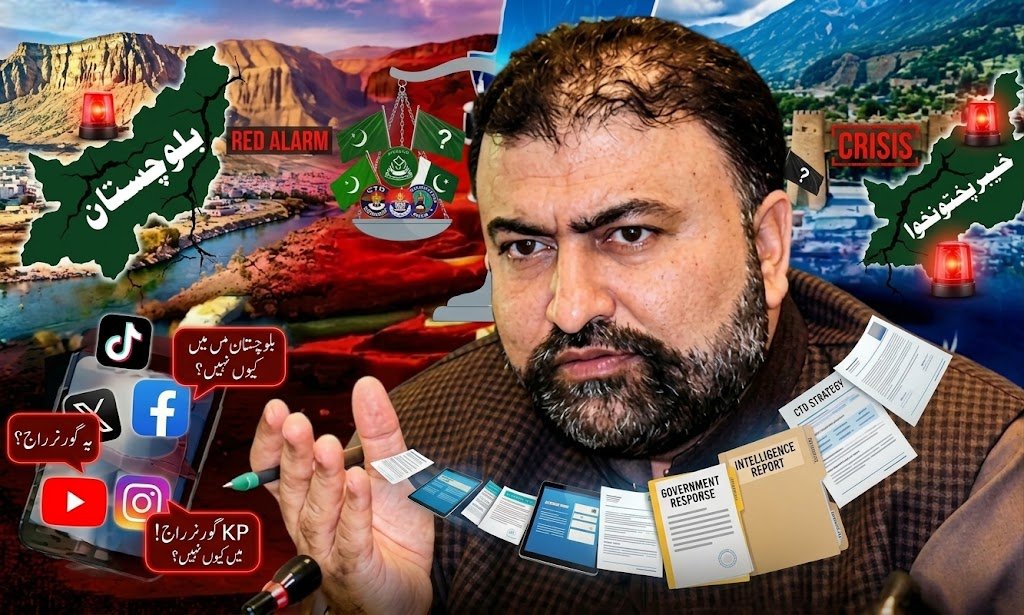
Balochistan Chief Minister Mir Sarfraz Bugti has rejected the comparison and drawn a distinction between the two provinces’ responses to terrorism. He argued that the two provinces face different circumstances and that a key distinction lies in how their provincial governments respond to the fight against terrorism.
Bugti backed the federal government’s move in KP, saying it had acted within the Constitution. He argued that the constitutional provisions governing such measures had been included by the country’s founders with different circumstances in mind.
However, the debate has increasingly centred on a question beyond the level of militant violence: whether a provincial government actively supports security operations or opposes the military’s counterterrorism strategy.
Bugti alleged that the KP government had used funds allocated for security to establish a social media team. He said provincial administrations had a responsibility to support security agencies, enact effective legislation and help build a public narrative against terrorism.
“Balochistan considers the war against terrorism its own war,” Bugti said, describing his government as committed to confronting the threat and accepting responsibility for the province’s security challenges.
He maintained that provincial governments must demonstrate their commitment through practical measures rather than statements alone.
Cooperation with security forces at the centre of debate
The chief minister’s remarks come amid a wider political dispute over the role of the PTI-led government in KP and its approach to military operations against militant groups. Critics have accused the provincial leadership of opposing certain operations, while the question of cooperation between civilian authorities and security agencies has become a central point of contention.
Bugti argued that governments must provide security institutions with political and administrative support in the fight against terrorism. His comments effectively framed cooperation with security forces, rather than the mere presence of militancy, as a key difference between the two provinces.
He also referred to the deaths of political leaders and workers from different parties in terrorist attacks, questioning why a particular political group had not faced similar targeting. However, he said he did not want anyone to be attacked and was raising the issue as a question about the broader security situation.
Recalling his visit to Sui a day earlier, Bugti said unidentified individuals had set off hand grenades and crackers at a distance. He argued that the situation would be different if his government did not regard the fight against terrorism as its own responsibility.
Bugti also questioned statements concerning the return of those responsible for the killings of former prime minister Benazir Bhutto, Bashir Ahmed Bilour and the son of former KP minister Mian Iftikhar Hussain. He said all members of the Balochistan Assembly stood against terrorism and in support of security forces.
Why was Balochistan not the first province to face governor’s rule?
The social media debate has raised a broader question: if terrorism and deteriorating security are central reasons for imposing governor’s rule in KP, why has Balochistan not faced the same measure despite its own prolonged struggle with militancy?
Bugti’s response is that the two provinces cannot be judged on security conditions alone. In his view, the willingness of provincial governments to accept responsibility, cooperate with security agencies and support counterterrorism efforts is also crucial.
Nevertheless, his allegations about the use of security funds in KP and the provincial government’s approach to military operations require a response from the relevant authorities. The claims should not, on their own, be treated as independently established facts.
The debate also raises constitutional and political questions about the circumstances in which federal intervention becomes justified, and whether differences in provincial cooperation are sufficient to explain why such a measure is considered in one province but not another.
Also Read: KPK Assembly Will Be Restored in Six Months, Says Rana Sanaullah
Ultimately, the issue extends beyond a comparison between KP and Balochistan. It concerns how effectively federal and provincial governments fulfil their constitutional and administrative responsibilities, coordinate with security institutions and develop a common strategy against militancy.
The central question remains whether governor’s rule is being considered primarily because of the security situation in KP, the provincial government’s handling of that situation, or a combination of both.