TORONTO: In the realm of cricket, rare and astonishing moments occasionally unfold that leave players, commentators, and spectators entirely bewildered, much like a unique incident witnessed during the Canada Super 60 semifinal between the Toronto Sixers and the Mississauga Masters.
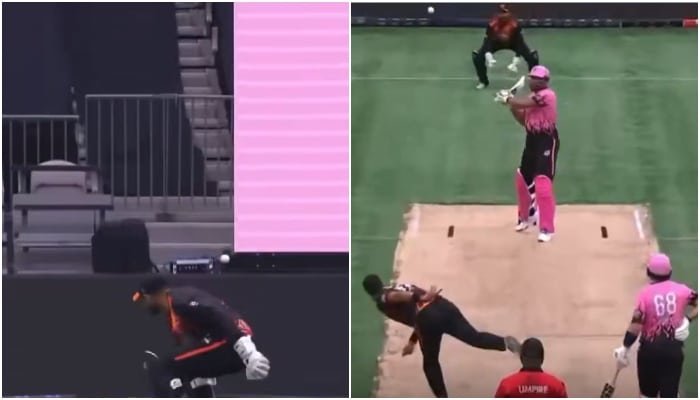
Fast bowler Ali Khan, representing the Mississauga Masters from the United States, delivered a ferocious bouncer to renowned West Indian all-rounder Kieron Pollard.
The delivery soared directly over the batsman’s head, sailed past the wicketkeeper, and landed straight across the boundary ropes.
Although this spectacle during the Canada Super 60 match visually resembled a magnificent maximum because the ball traveled straight past the ropes right out of the bowler’s hand, the on-field umpire signaled a wide and indicated four runs, awarding the Toronto Sixers a total of 5 runs—comprising one run for the wide and four runs for the boundary.
The primary reason the umpire refrained from signaling six runs stems from the fact that Kieron Pollard did not make any contact with the ball.
According to the Laws of Cricket established by the Marylebone Cricket Club (MCC), a stroke can only be officially declared a six if the ball touches the bat or the batsman’s gloved hands prior to crossing the boundary and travels over the ropes without touching the ground.
Consequently, even though the delivery effectively sailed out of the ground like a six, it was officially recorded as four boundary runs alongside a wide extra, yielding 5 runs in total.
Ultimately, Toronto secured a 9-run victory in this thrilling encounter to book their spot in the Canada Super 60 final.
A Comprehensive Review of Interesting and Unique Cricket Rules
Cricket is frequently celebrated as a game governed by meticulous laws, featuring intricate and fascinating regulations capable of astonishing fans worldwide. Listed within the MCC rulebook, several provisions highlight the uniqueness of the sport:
- Timed Out: This rare rule dictates that an incoming batsman must reach the crease and be ready to face the next delivery within a designated timeframe (typically 2 minutes in limited-overs formats and 3 minutes in Test cricket) following a dismissal. Failing to arrive within the allotted window can result in an out if the fielding side appeals.
- Runs from a Helmet: If a bowled ball bypasses the batsman’s body or bat and strikes a spare helmet placed on the ground behind the wicketkeeper, the laws mandate a 5-run penalty against the fielding team, which is directly added to the batting side’s total.
- ICC Probes Canada vs New Zealand T20 World Cup MatchALSO READ:
- Reverse Sweeps and Fielding Restrictions: Modern T20 cricket has fundamentally revolutionized stroke-play styles. When executing reverse sweeps or ramp shots, batsmen frequently alter their stance dynamically, creating intriguing legal debates regarding wide-line demarcations and traditional fielding constraints for umpires and bowlers.